When Slate + Ash release something new, it’s always worth paying attention. Their libraries tend to straddle that fascinating line between instrument, texture machine, and art installation, and RUINS is no exception. Marketed as a “sonic excavation,” this €279 (€199 intro) Kontakt Player instrument transforms the electric guitar into a tool for exploring collapse, memory, and texture. Lofty words—but does it deliver?
The short answer: absolutely.
A Sonic Excavation of Guitar
At its core, RUINS is built from recordings of six experimental guitarists, curated and produced by Randall Dunn (also known for his work on Spectres). These performances were broken down into fragments, loops, and textures before being reconstructed inside Slate + Ash’s engine.
What makes it special is how far it moves from the idea of “guitar library.” Yes, the guitar is the raw source, but the resulting palette stretches from atmospheric pads and textural beds to broken, distorted noise-scapes that feel almost unearthly.
As I said in the review:
“You can definitely hear the guitar influences, but it’s by no means something I’d only recommend you think of as a guitar-style cinematic library. A lot of the sounds here really have nothing to do with guitar—and that’s the beauty of it.”
Engines & Presets
The instrument provides two main playback engines:
- Multi-Sample Engine – layers guitar phrases into rich, shifting harmonies, with asynchronous looping that adds life and instability.
- Single-Sample Engine – takes raw details like string scratches, amp hum, or fragments, and reimagines them into rhythmic or tonal elements.
On top of this, you get collage and spatial engines, plus modulation, convolution reverbs, and layering options.
The result? Over 250 articulations, 281 presets, and 4,636 raw WAVs, amounting to about 22GB of content.
And the sound design is extraordinary.
“I mean, just the sound design level here is insanely good… These libraries aren’t just great sounding, they’re inspirational. They bring me ideas I can actually develop into compositions.”
The Sound of RUINS
From my playthrough, a few categories stood out:
- Atmospheres & Pads – Textural, cinematic, and full of life. Subtle fluctuations in pitch and tone make them feel alive. One pad in particular I called: “Top tier… unbelievably beautiful. It feels like it’s truly alive.”
- Collages – Inspired by tape manipulation, these combine fragments into unpredictable, evolving textures. Great for when you want inspiration to spark a composition.
- Ruins (Distorted Textures) – This was my personal highlight. “I’ve never heard aggression and brokenness in a sonic context taken to the max, but still so well balanced. This does that better than anything I’ve ever heard.”
- Tones & Movements – More tonal, sometimes rhythmic, sometimes synth-like. They provide usable, playable ideas while still carrying Slate + Ash’s signature sense of depth and texture.
The bottom line: whether you need fragile ambient layers, raw cinematic destruction, or subtly shifting tonal beds, RUINS has it.
Interface & Workflow
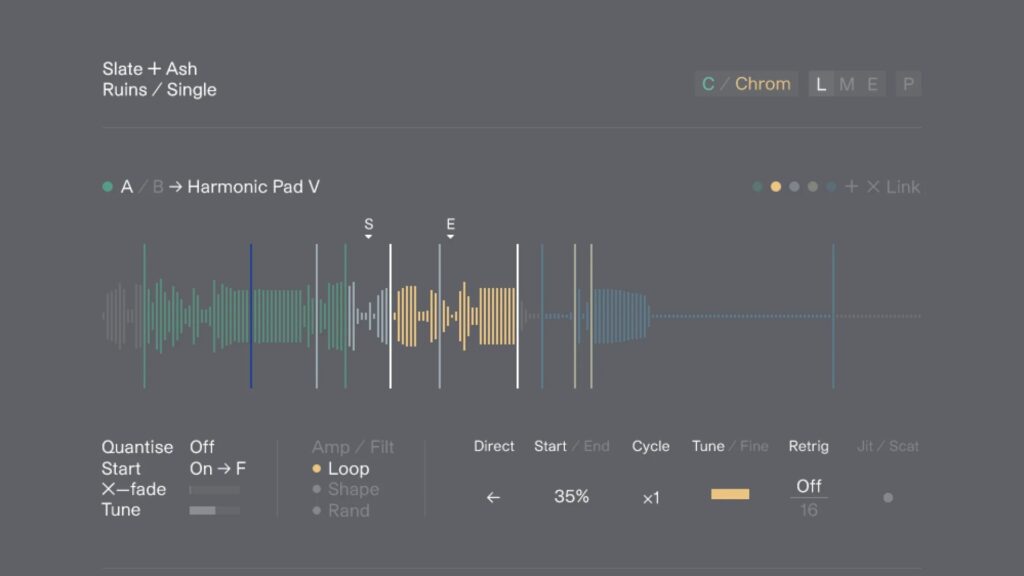
Like other Slate + Ash instruments, RUINS uses a minimalist interface. It’s sleek and modern, though it can feel opaque at first. The lack of handholding means there’s a learning curve, but once you know your way around, it gets out of the way and lets you focus on sound and creativity.
I found the single sound design folder to be the most polished and inspiring area. The multis are also great, though they feel more like starting components to build from, whereas the singles often feel like finished, production-ready textures.
Final Thoughts
Slate + Ash have done it again. RUINS is one of the hardest libraries to summarize because it covers so much ground: ambient, cinematic, experimental, tonal, broken, beautiful. It’s not “just a guitar library.” It’s a tool for storytelling through texture.
If you’re a composer working in film, games, or experimental music, this is an endlessly inspiring instrument. For me, it immediately joins the ranks of Slate + Ash’s most exciting releases.
“These libraries aren’t just sound design—they’re compositional catalysts. And RUINS is one of the most inspiring I’ve used.”
Prefer video? 🎥🎧
If you’d like to hear RUINS in action, check out my full video review here: https://youtu.be/XokNOt7UaUA
Or watch the “No Talking” demo version here: https://youtu.be/PrMgkkdHrIg