Convergence is one of those libraries where you don’t quite know what you’re getting just by reading the marketing copy — and in this case, that’s both a weakness and a strength.
On paper, it’s described as a collision of iconic analog character and modern scoring power. In practice, it ends up being something more specific: big, juicy analog-leaning synth sources that are pushed through Heavyocity’s signature digital processing pipeline, resulting in sounds that feel subtly altered, twisted, gritty, cinematic, but highly refined at the same time.
This was a completely blind demo for me. In my typical fashion I deliberately avoided digging too deep beforehand so I could react to the sounds as they are — and Convergence ended up being a very positive surprise.
First Impressions & Positioning
Convergence doesn’t come with a subtitle, which already sets it slightly apart from other Heavyocity releases. There’s no obvious “this is for X” label attached to it.
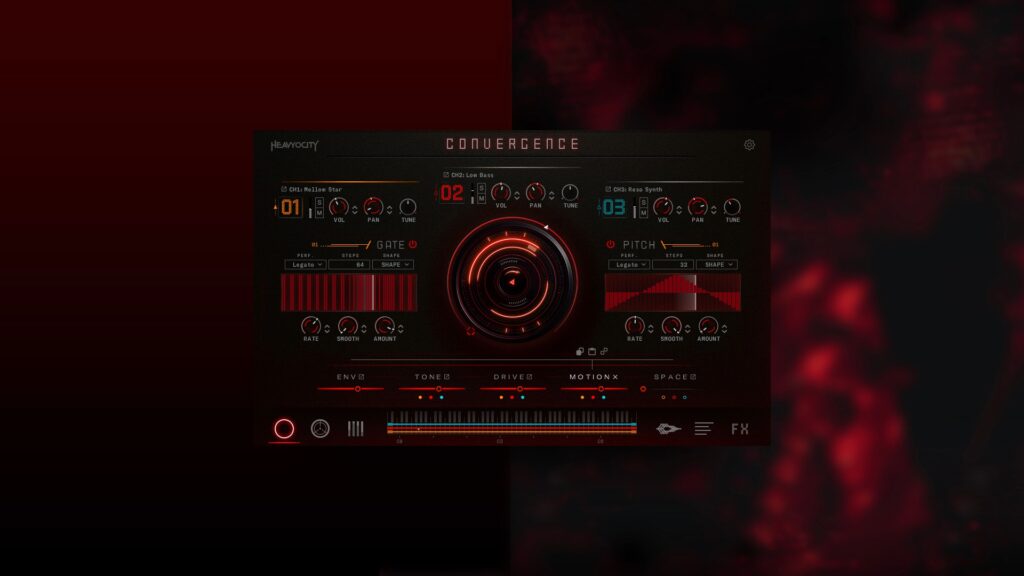
Visually, though, the intention is clear: darker tones, analog synth aesthetics, cinematic colors. The website copy hints at genre-defying sound design and hybrid scoring, but doesn’t go very specific. That made me curious — and also a bit skeptical.
After spending time inside the library, I’d describe Convergence like this:
Large analog synth foundations that are intentionally slightly digitized, degraded, mildly warped, and texturized into a dark, cinematic hybrid.
There are very strong shades of dark ’80s synth aesthetics here, some synthwave DNA, but it leans far more cinematic than retro.
Engine & Interface
Convergence runs on the Gravity 2 engine, which at this point is a known quantity — and a very strong one.
If you’ve used Gravity 2, Oblivion, or similar Heavyocity libraries, you’ll feel immediately at home:
- Clear sound browsing
- A powerful sequencer
- Zone-based triggering
- Fast, intuitive macro control
Nothing here fights you. The interface stays out of the way, which matters when you’re auditioning a lot of presets and making fast creative decisions.
Visually, there’s a subtle shift toward a more digital, slightly ’80s-inspired UI aesthetic, but functionally this is classic Heavyocity — and that’s a good thing.
Categories & Content Overview
Convergence is built around the following main categories:
- Cue Creators
- Rhythmic Pedals
- Arps
- Pads (Blooms, Ambient, Aggressive)
- Keys
- Plucks & Stabs
- Leads
- Basses
For this review, I focused heavily on Cue Creators first, because they give the clearest picture of the library’s overall sound identity. After that, I sampled the other categories more selectively.
Cue Creators – Where the Library Reveals Itself
Cue Creators are where Convergence really clicks.
These presets do an excellent job of communicating the core idea of the library:
analog weight + digital alteration & crunch + cinematic motion.
A recurring theme here is contrast:
- Warm, solid analog foundations
- Digital modulation, warping, and degradation layered on top
- Subtle rhythmic movement rather than flashy complexity
One particularly important aspect is the zone system. Many Cue Creators rely on zones to trigger different layers or behaviors, and understanding this is key to getting the most out of them. Once you’re aware of how zones are driving the sound, these presets make a lot more sense — and become much easier to tweak.
Sonically, this category consistently hit a sweet spot for me:
- Dark, cinematic
- Slightly shifting and bending
- Never harsh or fatiguing
- Very playable
There’s a recurring “analog meets digitized world” feeling here that runs through the entire library.
Sound Character: Analog First, Digital Second
If I had to summarize the sound design philosophy behind Convergence, it would be this:
Take something pure and analog — then deliberately but subtly alter it.
Many sounds feel like they start as classic synth material and are then pushed through digital processes that introduce grit, instability, and texture. But crucially, this never crosses into unpleasant territory.
This is something Heavyocity has been refining since Gravity 2:
- Sounds feel full and present
- Crisp edges without harshness
- Impactful but not fatiguing
It’s a difficult balance to strike, and Convergence handles it very well.
Rhythmic Pedals & Arps
As expected, the Rhythmic Pedals are excellent.
These tend to be one of my favorite Heavyocity categories in general, and Convergence doesn’t disappoint. The rhythms are:
- Subtle rather than flashy
- Dark and understated
- Very usable as building blocks
Triplet rhythmic pedals are included (thankfully — they’ve become a staple in Heavyocity libraries), and they add a lot of flexibility when shaping motion without overcomplicating arrangements.
The Arps follow a similar philosophy: restrained, musical, and easy to place in a mix.
Pads – Texture Over Flash
The pad section is divided into Blooms, Ambient, and Aggressive, and the quality is unmistakable — especially if you’ve enjoyed Heavyocity’s previous pad work. Dystropia’s pads were outstanding, and I’m happy to say Convergence carries that same level of quality and attention to detail.
The pads lean more toward texture and atmosphere than big sweeping statements, which fits the library’s identity well.
Keys, Plucks, Leads & Basses – A Pleasant Surprise
I was genuinely surprised by how much I liked these categories.
Historically, I tend to lean more on rhythmic and textural material from Heavyocity libraries, but here:
- The keys are rich and expressive
- The plucks and stabs are punchy and characterful
- The leads, in particular, stood out
The leads avoid a common trap: instead of being overly wide and aggressive, many of them are laser-focused, sharp, and mix-friendly. They cut through without bloating the soundstage, which makes them far more usable in real compositions.
The basses also hold up well, reinforcing the library’s overall weight without sounding too blocky or bulky.
Workflow & Real-World Use
One of the strongest aspects of Convergence is how well it supports fast idea generation.
The presets sit in a space where:
- You immediately understand what they’re doing
- You can quickly decide whether they spark an idea
- If they do, the engine lets you refine them fast
This is the same reason I’ve leaned heavily on other Heavyocity libraries for projects like Breachway: cohesive sound, fast customization, and consistent quality.
Convergence fits neatly into that ecosystem.
Final Thoughts
Convergence exceeded my expectations.
It doesn’t try to be everything, and it doesn’t rely on nostalgia alone. Instead, it offers a focused, confident sound identity:
- Juicy analog foundations
- Digitally twisted and textured
- Dark, cinematic, and modern
- Does that dark ’80s synth sound, but with a dark, playful, and fresh feel to it
If you’re looking for:
- Cinematic synth material with character
- Sounds that feel big without being fatiguing
- A library that rewards tweaking but doesn’t require it
…then Convergence is a very strong option.
At its price point — especially with any intro or crossgrade discounts — it’s an easy recommendation if this sound world speaks to you.
Prefer Video?
🔍 Full Deep Dive: https://youtu.be/zcvlGO_fQI8
🤫 No Talking Demo: https://youtu.be/iZZDkZiWp3c