There are soundsets that give you presets.
And then there are soundsets that give you a direction.
Osiris is very clearly the latter.
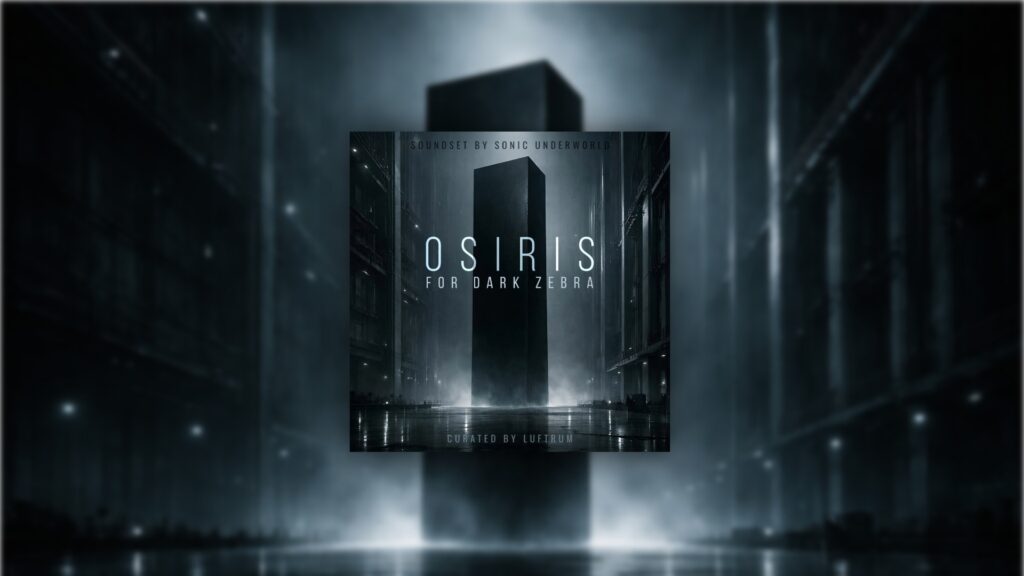
This is not just another generic expansion for u-he’s Dark Zebra. It’s a tightly themed, deliberately sculpted industrial-cinematic collection created by Sonic Underworld and curated by Luftrum — and it shows in every category.
Let’s break this down properly.
What Is Osiris?
Osiris is a 200-preset soundset for u-he Dark Zebra (the Hans Zimmer-associated variant of Zebra 2).
It leans into:
- Industrial cinematic tension
- Bright distorted harmonics
- Controlled chaos
- Mechanical precision
- Upper-register aggression
Unlike previous darker, low-end-focused releases, Osiris shifts upward. It explores friction, edge, and distorted harmonics in a way that feels engineered — not accidental.
And that distinction matters.
The First Impression: Precision Without Harshness
Whenever I see “bright,” “distorted,” and “industrial” in the same description, I get slightly cautious.
That combination can easily become brittle or fatiguing.
Osiris doesn’t.
What surprised me immediately was this:
It’s crisp and sharp — but not harsh.
It’s aggressive — but not nasty.
It cuts — but it doesn’t stab.
There’s a freshness to the top end. A kind of clean machining quality. Many of these sounds feel milled to exact tolerances.
You hear intention everywhere.
Arps – Controlled Chaos That Breathes
The arps were some of my immediate favorites.
They have this simmering, bubbling behavior — not organic in a “real-world” sense, but organic in motion. You can’t fully predict what each micro-movement will do next, and that unpredictability creates inspiration.
They’re:
- Clear
- Hyper-defined
- Restrained and balanced in the low end
Most importantly, they sit beautifully in a full mix.
They imply low-end drive without overwhelming it. That’s huge if you work with orchestral layers for example like I do. These don’t fight your strings and brass — they enhance the perception of momentum.
That’s thoughtful design.
The Bass Category – Precisely Crafted
Here, the design philosophy became obvious.
These basses:
- Keep the fundamental controlled
- Use upper harmonics to create drive
- Contain subtle sub reinforcement below the main focus
This means you get perceived weight without low-end clutter.
For cinematic writing — especially hybrid orchestral — that’s gold.
Too much bass fundamental and your orchestra shrinks.
Too little, and you lose impact.
Osiris hits that balance deliberately.
Some of these presets feel like they could easily evolve into pads or hybrid textures with minor tweaking. And that’s one of the strengths here: these are starting points, not rigid endpoints.
Drums – Machine Clean
I’m not a heavy synth-drum user most of the time, but I have to say:
These are extremely well tuned.
- Clean kicks
- Sharp hats
- Metallic percussion with character
- Nothing bloated
Again, that machine-precision theme appears. They cut. They don’t clutter.
Loops & Sequences – Inspirational Starting Points
There’s a solid amount of looped and sequenced material.
Personally, I tend to:
- Extract the sound
- Disable the internal sequencing
- Play my own MIDI
But the patterns themselves are strong compositional prompts.
Even if you don’t use them as-is, they spark ideas. And that’s valuable.
The sound types within these categories vary widely, spanning everything from basses and leads to keys and beyond.
Pads – Dark, Cinematic, Emotional
This is home territory for me.
The pads here are:
- Spacious
- Tonally rich
- Often containing harmonic “crumbs” in the upper spectrum
- Emotionally charged
A few would benefit (for my taste) from slightly reducing upper aggression — but that’s the beauty of soundsets. You can go in and tweak.
Underneath the edge, there are beautiful cores waiting to be shaped.
Leads & Synth Category – Function Matters
This is where context becomes important.
On their own, some of the more aggressive synths may sound harsh.
But that’s missing the point.
Osiris is deliberately themed. It’s not trying to be a “do everything” expansion. It’s trying to be a very specific tonal tool.
These leads are meant to cut through.
In a dense cinematic mix, they’ll make sense.
And if you want less bite? You’re using Dark Zebra. Tweak it.
Overall Sound Character
The defining traits of Osiris:
- Clinical precision
- Controlled harmonic distortion
- Industrial edge
- Upper-frequency energy
- Cinematic mix awareness
- Designed utility
Nothing sounds accidental. Nothing feels lazy.
It’s cohesive.
Who Is This For?
If you:
- Write cinematic or hybrid orchestral music
- Work in industrial electronic
- Are looking for dark-toned driving sounds for electronic music
- Score games
- Want upper-register drive without low-end mud
- Appreciate highly curated thematic sound design
Osiris will have immediate practical value.
For me personally?
The arps and basses are going straight into the toolbox.
Final Verdict
I wasn’t surprised — because the track record behind this collaboration is strong.
But I was impressed.
Osiris fills a very specific slot in the Dark Zebra ecosystem:
A bright, edgy, mechanically precise cinematic toolkit.
It’s not trying to be everything.
It’s trying to be this.
And it does that exceptionally well.
Get it here: https://www.luftrum.com/presets-dark-zebra/
Prefer Video?
🕵🏻♂️ Full Deep Dive: https://youtu.be/xlvoiLsLc8g
🤫 ‘No talking’ Demo: https://youtu.be/JTRttwwCxEc