Most sample libraries are built around a clearly defined instrument: a piano, a string section, a synth.
Some expand that idea into combinations of instruments.
The great ones achieve something more elusive — a feeling.
And every now and then, a library appears that manages to do all three.
Outlines by THEPHONOLOOP belongs firmly in that rare category. It’s not a traditional instrument library, nor is it purely a sound design playground. Instead, it lives somewhere between composition tool, atmospheric palette, and sonic sketchbook — a place where raw acoustic recordings, tape artifacts, modular processing, and subtle noise blur together into something that feels strangely alive.
It’s not just about playing notes.
It’s about shaping atmosphere. Emotion. Time. A sense of place.
And that distinction makes all the difference.
Expanding the Palette
Before diving deeper into Outlines, it’s worth briefly touching on what THEPHONOLOOP has become known for.
Few developers have cultivated such a distinct sonic identity. Their instruments live in that fragile space where lo-fi imperfection, texture, and atmosphere intertwine. Tape artifacts, mechanical noise, distant ambience — the kinds of details most libraries try to hide become part of the music itself.
The previous release, themkI, proved just how powerful that philosophy can be when focused on a single instrument.
Outlines, however, takes a very different approach.
Instead of building the library around one source, it draws from a wide palette of instruments and textures.
Which naturally raises a question.
Are they trying to take on too much?
Fortunately, after spending time with the instrument, the answer becomes clear.
They aren’t.
What Outlines Actually Is (And What It Isn’t)
Before diving into the experience of using the library, it’s worth clarifying expectations.
Outlines isn’t a conventional orchestral library. It isn’t a pure synth instrument either. Nor is it a typical collection of acoustic instruments. And despite the lo-fi aesthetic associated with the developer’s earlier releases, it’s not simply another tape-texture toolkit.
The developers described the library succinctly as something that:
“Outlines blends raw acoustic textures and tonal experiments with tape loops and modular processed textures.”
That description turns out to be highly accurate.
Across the presets you encounter bells, strings, woodwinds, piano tones, and abstract processed sources — but they rarely appear in isolation. Instead, they’re woven together with brilliant sequencing and signal processing, subtle and tasteful ambience, tape coloration, granular movement, and carefully curated noise layers.
What emerges isn’t a collection of isolated instruments.
It’s a textural ecosystem.
A Library Built Around Feel
One of the first things that stands out when exploring Outlines is just how deliberate everything feels.
The library doesn’t overwhelm you with complexity right away. Instead, it invites you to play.
And the moment you start moving through presets, the character of the sound design becomes obvious.
“The details in the texture here is so beautiful.”
That attention to texture defines the entire experience.
There are tiny elements buried inside these sounds — faint environmental ambience, subtle tape motion and artefacts, mechanical rattles, filtered hums — that may not always jump out immediately, but they shape the emotional character of the instrument.
Sometimes the effect is obvious.
Other times it’s almost subliminal.
But it’s always intentional.
“All the noises, all the textures, all the detail… it’s beautifully open and vulnerable, but… so polished, so balanced, so refined.”
That balance — between rawness and refinement — is one of the hardest things to get right in sound design.
Outlines pulls it off remarkably well.
The Engine Behind the Sound
Outlines runs on the same core engine that powered THEPHONOLOOP’s earlier electric piano library, themkI (one of the best sample library releases of 2025), and it remains one of the most creatively satisfying Kontakt engines I’ve worked with.
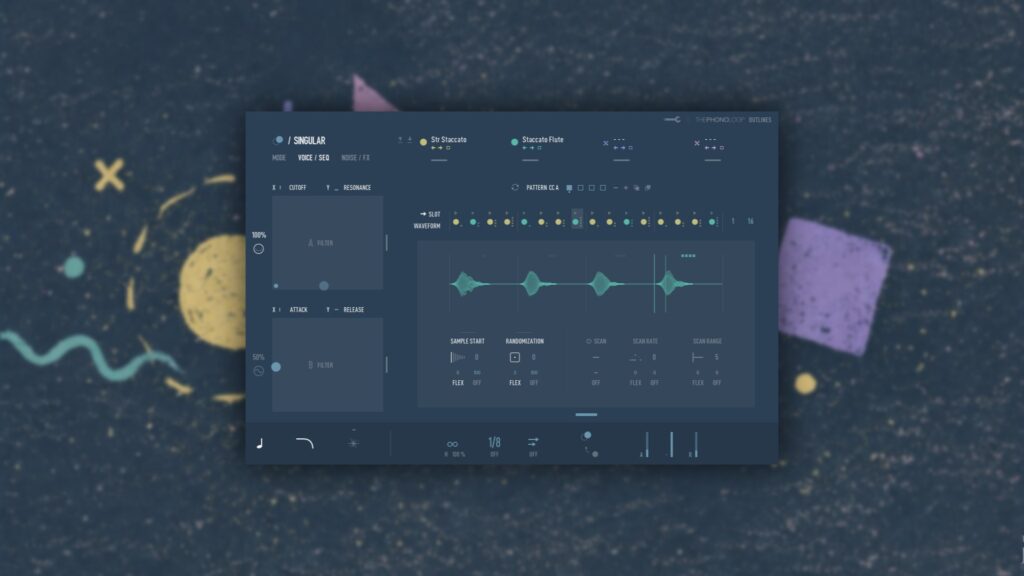
Rather than forcing you into a single creative workflow, the instrument offers several behavioural “modes” that fundamentally change how sounds respond and evolve.
I tend to think of them as engines within the engine. Each mode subtly changes the “laws of nature” of how the instrument behaves. Creatively speaking, they offer different compositional and inspirational perspectives.
A static acoustic recording can suddenly become something abstract and evolving.
An already cool preset can transform into something entirely new and exciting with the press of a button.
Because the engine allows layering of sources alongside complex sequencing and signal processing, the palette becomes remarkably deep.
What I appreciate most is that the engine encourages experimentation without demanding it.
You can dive deep into modulation and sequencing — or simply play.
Despite the wonderfully deep possibilities for tweaking, the instrument never becomes tedious or difficult to work with. The creative process feels generative rather than cumbersome or backwards-looking. For all its depth, the instrument remains remarkably easy to play and explore.
Minimalism That Works
The interface follows THEPHONOLOOP’s now familiar design philosophy: minimal, elegant, and intentionally restrained. At first glance it may feel a little unusual, and the learning curve might not be for everyone. But give it a bit of time — and ideally a quick read through the manual — and the logic quickly reveals itself.
The interface avoids clutter, unnecessary labels, and deep menu structures, which means that once you understand where things live, working with the instrument becomes surprisingly fast and intuitive. The browser deserves special praise as well: cleanly organized, colour-coded, quick to navigate, and perfectly suited for exploring the library’s many textural possibilities.
Noise as a Musical Element
One of the defining characteristics of THEPHONOLOOP’s work has always been their approach to noise.
Not as an afterthought.
But as a compositional ingredient.
Outlines continues that philosophy in full force.
“These guys are like the connoisseurs of noise… they just know it really well.”
In many libraries, noise layers are generic: tape hiss, vinyl crackle, maybe some environmental ambience.
Here, they’re curated with almost obsessive care.
A tiny electrical whine might subtly shape the emotional tone of a pad.
A faint mechanical rattle might add tactile realism to a mallet sound.
A distant environmental recording might shift the atmosphere of an entire patch.
Sometimes you barely notice these elements consciously.
But remove them — and the sound collapses.
Acoustic Sources With Unexpected Depth
One of the biggest surprises in Outlines is not just the range of instruments it offers, but how strong the sampling is.
You might expect the library to lean heavily on processed textures and experimental sound design — and it certainly does.
But the raw recordings themselves are superb.
Take the strings, for example.
“Those are beautifully sampled. Very natural, very organic.”
Or the piano tones, which sit somewhere between lo-fi character and a vulnerable, raw upright piano with great playability.
“It literally feels like honey is oozing out of my fingers.”
That comment may sound exaggerated, but the sentiment captures something very important.
Many textures in Outlines are not just ear candy — they remain expressive instruments first, and sound design tools second.
They respond to velocity beautifully.
They layer dynamically.
They reward musical phrasing.
That makes them highly expressive and inspirational.
Where It Really Shines
While the acoustic recordings are impressive, the real magic happens when the engine begins layering and transforming them.
Here the library moves beyond simple instrument sampling into something far more dynamic, textural, and alive — often even cinematic.
A bell might trigger a rhythmic texture.
A string layer might morph into an evolving pad.
A tape-processed synth might sit underneath everything, quietly shaping the emotional tone.
And suddenly the soundscape feels like it belongs in a film score.
“They just sit perfectly — instant movie-ready vibe.”
That phrase — movie ready — is one that kept coming to mind while exploring the orchestral sounds of this library.
Many patches feel like they could drop directly into a cue.
No additional processing required.
No extensive layering necessary.
Just play.
A Remarkable Sense of Cohesion
What’s particularly impressive about Outlines is how cohesive the library feels despite drawing from so many sources.
Strings, bells, pianos, synths, tape textures, field recordings — all of it could easily have become chaotic and lackluster.
Instead, everything seems carefully tuned to the same aesthetic center.
“Layers upon layers of texture… all intertwined, interlocked in the most beautiful considerate fashion.”
That cohesion means you can move through presets and still remain inside a consistent sonic world.
This is highly valuable for composers and music producers.
It allows you to build entire cues — even entire tracks — while staying within the same palette.
The Pads Alone Are Worth Exploring
There are many breathtaking sounds in Outlines — plucked guitars, pianos, and wonderfully plucky, blippy synths. But one category in particular really stopped me in my tracks: the atmospheric pads.
These aren’t the typical washed-out synth beds you find in many libraries. Instead, they combine motion, grit, and harmonic depth in ways that remain surprisingly clear in the mix.
“This manages to be simultaneously like sparse, broken, but still… beautifully full.”
That balance is extremely difficult to achieve.
Pads tend to become muddy or overly dense when layered heavily.
Outlines avoids that problem with careful frequency balance and subtle motion inside the sounds themselves.
The result is a set of atmospheres that feel alive rather than static.
Who This Library Is For
Outlines will resonate most strongly with composers, music producers, and artists who value texture as a musical element.
If you write lo-fi music, cinematic music, ambient scores, modern game soundtracks, hip-hop, pop, or atmospheric electronic work, there’s a high chance this library will feel immediately inspiring.
It’s a fantastic sketching tool and a playground of inspiration.
Most presets already contain a high level of movement, rhythm, and harmonic context, making them excellent starting points for ideas. From there, even small tweaks — like switching modes — can transport you into an entirely different world.
While I consider the strings and woodwinds a fantastic addition to my template, offering beautiful raw, organic tones and textures, composers looking for more clinical, traditional orchestral instruments or pristine studio recordings may find the aesthetic too stylized.
This is not about pristine.
It’s about character and emotion.
Final Thoughts
Outlines feels like a natural evolution of THEPHONOLOOP’s philosophy.
The company has always excelled at blending acoustic recordings with textural processing. Here, they expand that concept into a much broader palette — one that includes orchestral elements, modular experimentation, and beautiful acoustic instrument recordings.
The result is a library that feels both focused and expansive.
Focused in its aesthetic.
Expansive in its creative potential.
And perhaps most importantly, it’s simply fun to use.
You start browsing presets and suddenly an hour disappears.
Which is often the best sign that a creative tool is doing something right.
Get it here: https://thephonoloop.com/collections/instruments/products/outlines
Prefer Video?
✨ Editorial Spotlight: https://youtu.be/dVKLGQgKZ64
🕵🏻♂️ Full Deep Dive: https://youtu.be/c-jY98bSC8M
🤫 ‘No talking’ demo: https://youtu.be/Od9jybbc5vI