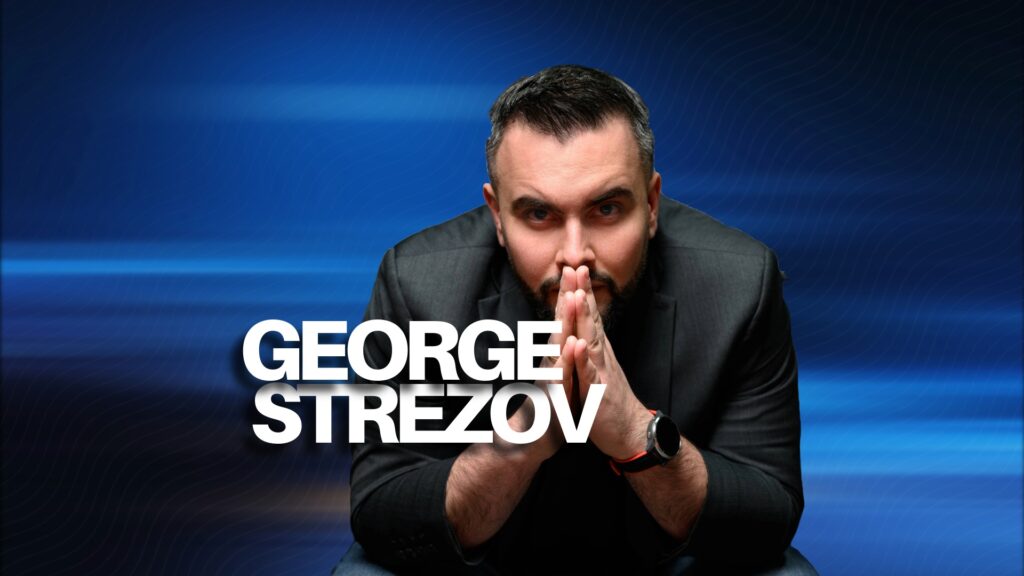
When I sat down to talk with composer George Strezov, I expected to geek out about film scores, orchestration, and maybe some game music nostalgia.
We did that.
But what surfaced underneath the stories — about Baldur’s Gate, about the National Academy of Music, about being told film music isn’t “serious” — was something more useful.
Not career advice.
Not technical breakdowns.
A pattern.
A pattern about how creative identity forms.
How institutions shape you — and push against you.
How atmosphere matters more than correctness.
And why, at some point, you have to create something that belongs only to you.
That’s what stayed with me.
The Pure Artist
George grew up around art.
A chemist father who mapped underground rivers.
An art historian mother.
An uncle who painted Renaissance-style saints and refused to give them to cathedrals.
The church loved the painting.
He kept it anyway.
“He’s just doing art for the sake of art.”
Most of us don’t operate like that. We can’t. We work with clients, deadlines, expectations. Film music, game music — they’re connected to products.
But having someone in your orbit who creates without financial framing changes you. It sets a reference point.
Not for income.
For integrity.
You may not live there permanently.
But you know it exists.
Institutions Preserve the Past
George entered the National Academy of Music as someone who loved film scores.
He left knowing something uncomfortable.
Institutions don’t reward the future. They preserve the past.
When he asked if he could observe a rehearsal of The Lord of the Rings, he was told:
“That’s not serious music. Don’t waste your time.”
Film music was commercial. Therefore inferior.
And yet those scores shaped millions of imaginations. Including his.
This is something many creatives experience. The thing that moves you most isn’t always respected by the gatekeepers.
Still, he didn’t reject the academy. He absorbed what was valuable: orchestration, conducting, phrasing, musical architecture.
He just refused to adopt the hierarchy.
Learn the craft.
Don’t inherit the prejudice.
When Writing Stops Being Calculation
George describes writing to picture as something that no longer feels analytical.
He doesn’t sit there calculating sync points.
He doesn’t consciously map every emotional beat.
“It’s kind of a reflex.”
It’s instinct meeting repetition.
Talent and vision — yes — but also years of doing it again and again until decision-making compresses.
At some point, you stop thinking about the mechanics and start responding to the scene.
Interestingly, even the parts of his education that didn’t align philosophically still shaped him.
Lessons about breath.
About phrasing.
About shaping tension across time.
Not because the academy endorsed film music.
But because musical tools are neutral.
They can always be used to express emotion.
Institutions don’t always support what we care about.
Still—
You absorb everything.
You discard the hierarchy.
You keep what serves the work.
Craft doesn’t care about ideology.
It cares about whether it moves something.
Atmosphere Over Accuracy
We talked about The 13th Warrior.
When mist rolls in before an attack, Jerry Goldsmith doesn’t reach for ethnographically correct Nordic instruments.
He uses a distant, reverberated piccolo.
It has nothing to do with authenticity.
Everything to do with atmosphere.
The sound becomes the mist.
When I asked George what drives him when he writes, especially outside strict genre expectations, he didn’t hesitate:
“Vibe all the way.”
That isn’t laziness. It’s prioritization.
Technicians ask:
Is this correct?
Artists ask:
Does this feel inevitable?
Audiences don’t experience your work analytically. They experience it emotionally.
Accuracy is optional.
Emotion isn’t.
Becoming Aware of the Power
One of the most important lessons George shared came early in his career.
He wrote a low, ominous drone for a scene where a boy discovers a gun.
The hallway is dark. The family is strained. The moment carries tension in the broader narrative.
So he added tension.
Low celli. Basses. A subtle rumble underneath.
It felt cinematic. Intentional.
A seasoned music editor stopped him.
Why are you telling the audience something bad is coming?
All we’re seeing is a boy playing.
At first, it stung.
But what stayed with him wasn’t embarrassment. It was realization.
“This is actually a very nice example of how powerful music is, because you can manipulate the viewer into emotions.”
That was the shift.
Not “never underline.”
Not “always be subtle.”
But: music steers perception.
You can foreshadow.
You can misdirect.
You can neutralize.
You can intensify.
And very often, the audience won’t even notice that you did.
That’s the responsibility.
Worlds First, Theory Second
George didn’t fall in love with composition through counterpoint exercises.
He fell in love with worlds.
Warcraft. Baldur’s Gate. Dungeons & Dragons.
Music wasn’t background. It was immersion fuel.
“Music is the shortcut of getting a person within the story.”
That line explains everything.
He wasn’t chasing harmony for its own sake. He was chasing atmosphere — the feeling of being inside something.
Some creatives think structurally first.
Some think emotionally first.
Neither is wrong.
But if you understand world-building, structure becomes a tool — not the point.
Ownership Changes Everything
After years of professional work, George realized something unsettling.
He had poured years into music he didn’t own.
The master recordings weren’t his.
The release timing wasn’t his.
The control wasn’t his.
That’s the reality of commercial art.
So he started releasing music for himself.
Weird combinations.
String quartet and piano.
Synths and bass clarinet recorded together.
No client logic.
No approval required.
“I think that’s very important… to have the place to experiment and no one to judge you.”
Professional work builds skill.
Personal work builds and expresses identity.
If you only do one, you lose balance.
Context Shapes Impact
George also made an interesting observation about video games versus film.
He feels that game audiences often care more deeply about music today.
Film scores are often buried under sound effects. Mixed lower. Treated as texture.
Games are immersive. Loop-based. Identity-driven.
When you spend 60 hours inside a world, its music becomes part of your emotional architecture.
The same composition can be wallpaper — or a lifelong memory trigger.
Environment shapes perception.
If you’re creating, think not only about quality, but about context.
Follow the Obsession
George described himself as a kid who skipped school to play Warcraft and Diablo. Saving character files onto floppy disks to continue leveling at internet cafés.
On paper: irresponsible.
In reality: obsessed.
Your early obsessions are rarely random.
Fantasy. Atmosphere. Narrative.
Years later, he’s writing for games and films — mediums built entirely on worlds.
Nothing was accidental.
Pay attention to what pulls you when nobody is watching.
The Real Tension
What I appreciated most about this conversation is that George isn’t rejecting commerce. He isn’t rejecting academia. He isn’t rejecting craft.
He’s rejecting false hierarchies.
Film music isn’t inferior because it’s commercial.
Avant-garde isn’t superior because it’s obscure.
Synths aren’t lesser than orchestras.
Atmosphere is not anti-intellectual.
Restraint is not weakness.
Vibe is not a shortcut.
The job isn’t to impress other musicians.
The job is to move human beings.
And if there’s one thread that runs through his story — from role-playing games to conservatory halls to professional scoring sessions — it’s this:
“Vibe all the way.”
Not instead of craft.
But in service of it.
Because in the end, people won’t remember your chord substitutions.
They’ll remember how it felt.
Prefer Video or Audio?
🔴 Youtube: https://youtu.be/9jiFHddzm14
🟣 Apple Podcasts: https://podcasts.apple.com/ca/podcast/music-that-builds-worlds-george-strezov-on-instinct/id1528017679?i=1000750148719
🟢 Spotify: https://open.spotify.com/episode/3FLadXySc4H1RO2PYyrFg0?si=sgg04-qzR2CKVuJxQFSoMw