There’s a particular quality some sample libraries chase — that liminal zone where an acoustic instrument reaching into another dimension but hasn’t quite become something synthetic. It’s the space between the real and the surreal, and most libraries that attempt it fumble the landing. Gethen, the latest release from Silence+Other Sounds, doesn’t just attempt it. It lives there.
Named after the perpetually frozen planet in Ursula K. Le Guin’s The Left Hand of Darkness, Gethen is subtitled “Arpeggios in Motion” — but don’t let that shorthand mislead you. This isn’t a conventional arpeggiator slapped onto a sample set. It’s a clever and creative dual-engine instrument that takes organic source material — solo strings, woodwinds, vocals, metallic percussion, plucked instruments — and processes it through a scanning, quasi-granular system that fundamentally recontextualizes the sound. The result is something I can only describe as a synthetic perception of organic performance. You hear a violin, and your brain initially reads it as being played — but then you sense that it isn’t. Not in a cheap or predictable way. In a way that feels genuinely new.
What Gethen Is — and Isn’t
Let me set expectations clearly. Gethen runs in full Kontakt 6.8 or above — no free player support. At an intro price of $79 (33% off at time of writing), it ships with over 1,100 handcrafted presets drawn from more than 150 sound sources across categories including solo violin, viola, cello, woodwinds, vocals, metals (waterphone, friction mallets, glockenspiel, bells), plucks (including an abstract mandolin), synths, and textures. It occupies roughly 8.8 GB unzipped — a surprisingly generous footprint for a library of this concept, suggesting real depth in the sampling.
This is not a traditional orchestral library. You won’t find legato patches or ensemble sustains here. What you’ll find is a compositional engine — a tool designed to transform simple chord input into complex, evolving arpeggiated textures. Think of the hypnotic, shifting patterns in the work of Philip Glass or Nils Frahm, but built from raw acoustic DNA and filtered through an engine that has a genuine personality of its own.
“It’s a really brilliant way of creating a synthetic feel for an organic instrument — not cheesy, not cheap, not predictable.”
The Engine — Where the Real Intelligence Lives
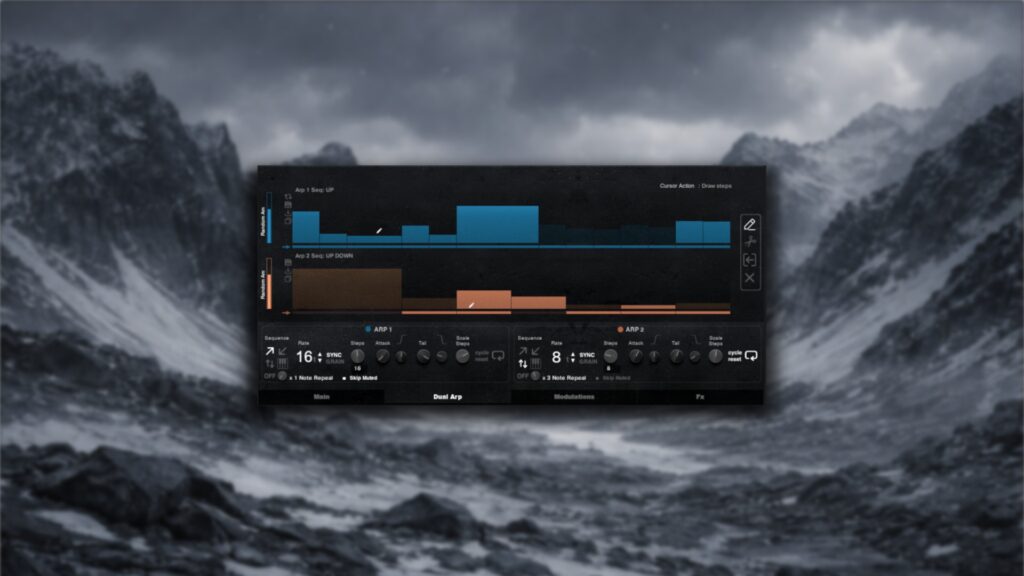
At the core of Gethen are two independent arpeggiators, and what sets them apart is how the engine responds to what you feed it. Load a sustained violin or a soprano vocal, and it behaves as a rhythmic granular engine, scanning and carving movement out of long tones — scrubbing through the waveform in a way that creates gliding, glistening transitions between sections of the sample. Load a short spiccato or a percussive hit, and it switches to a dynamic sequencer, triggering precise rhythmic patterns. The engine detects the sound type automatically. No configuration needed.
I can’t think of another arpeggiator that does this — that changes its fundamental behaviour based on the character of the source material. And it works remarkably well. The step sequencer lets you draw, merge, slice, and mute individual steps, while the step height on sustained sounds doesn’t control velocity but rather the playback position within the sample (in the sustains). There’s also per-step randomization, which adds organic variation without chaos when dialled tastefully. It’s the kind of system that gives you just enough controlled unpredictability to feel like something alive is happening under your fingers.
One particularly clever inclusion is the arpeggiator template system — separate from the presets themselves. You might have the right sound loaded but want to experiment with a completely different rhythmic pattern without losing your source configuration. These templates let you do exactly that, which speaks to a developer who actually thinks about how composers work in practice.
“The interactivity and creative loop here is super tight.”
Playing Gethen — What It Actually Feels Like
The playability here deserves its own conversation because it’s genuinely exceptional. I’ve played a lot of instruments built around engines like this, and most of them stumble when you push them — gaps appear, timing feels clunky, musicality breaks down when you get loose with your note placement. Gethen doesn’t do that. You can be imprecise, you can fumble your timing slightly, and the instrument still reads your intentions musically. At no point does it produce anything non-musical. That’s not a given with this kind of architecture, and it needs to be recognized.
The preset naming convention also deserves mention. Each preset name encodes useful metadata — whether it’s straight or triplet, whether it’s suited for fast, mid, or slow BPM ranges, the instrument involved, and even a note-count suggestion. It’s not prescriptive — you can play whatever you want — but it gives you a point of reference that saves real time when you’re browsing over a thousand presets. Combined with a “selected presets” highlights folder that pulls standout patches from across all categories, it’s clear that someone at Silence+Other Sounds thought carefully about the user experience beyond just the sound design. The downside of this naming approach is that locating your favourite presets can be more challenging and daunting, but both approaches have their tradeoffs.
“This is insanely playable. It just keeps up with you in the most musical, brilliant way.”
The Sound Categories — Highlights and Discoveries
The violins and violas are where Gethen first reveals its identity. The sustained string samples have a beautiful rawness — a sort of organic fighting quality, as though the sound is almost tearing itself apart. It’s beautiful, delicate, and vulnerable. When the engine scans through these samples, it produces a glossy, gliding texture that sits equidistant between acoustic and synthetic. It’s the kind of tone that would be perfect for scoring a sci-fi world where you want orchestral presence but with an unmistakably synthetic undertone — without reaching for actual synthesizers.
The cellos take things darker and more visceral. They carry a gooey, pressurized tone that leans into eeriness and disorientation. These presets gave me more of a directional feeling than an immediate “this is it” reaction — which is, honestly, exactly what good presets should do. They pointed me toward where I wanted to go, even if they needed more under-the-hood tweaking to get there (to my specific taste).
The augmented winds were where things truly elevated. Clarinet paired with pan flute. Trumpet breath layered beneath a woodwind line. Pairings I’d never have considered on my own, executed with a sensitivity that made me rethink what I know about instrument combinations. The woodwinds take exceptionally well to the engine’s scanning behaviour — producing a smooth, airy, glossy quality with just enough rasp and organic artifact to feel alive. Several presets in this category stopped me cold. I forgot I was making a video and just started composing. There’s no higher praise I can give a library than that.
“That has got to be one of the most beautiful sounds I’ve heard within a year.”
“When a library makes me forget about the video and just start composing, that’s the highest praise I can give.”
The vocals — recorded by Alessandra Cognetta, whose credits include Gladiator 2 and Star Wars: Acolyte — are handled with impressive restraint. The engine manages to preserve tonality even while shifting and scanning through the vocal samples, which is no small feat. The playability with vocal content is particularly remarkable; typically, this is where engines show their limitations, but Gethen just absorbs whatever you throw at it.
The metals, including waterphone and glockenspiel patches, maintain a warmth and fullness that’s rare for this type of sound. The glockenspiel in particular keeps a low-end thump while the top end sparkles without ever becoming harsh or fatiguing — which is exactly where most glockenspiel samples fail. The plucks, built around an abstract mandolin, have an anticipatory, soulful quality that immediately pulled me into writing mode. I only scratched the surface with the metals, and I’m looking forward to diving deeper into these soon, as they hold a ton of interesting textural potential.
And then there are the synths — which, frankly, have no business being this good. In many hybrid libraries, the synthetic content feels like an afterthought. Here, the synths are insanely well-produced, with gritty, detailed textures and percussive noise elements that complement the organic material superbly. They exist in the same sonic world as the acoustic sources, which is harder to achieve than it sounds.
“The synths have no business sounding that good — they are insanely well produced.”
“I love when instruments can teach me things about music and not just be a bunch of sounds.”
Interface — Clean, with Room to Grow
The interface is stylized, clean, clear, and doesn’t clutter the brain. Everything is very easy to locate and follow, and a pleasure to use. The modulation matrix is simple and intuitive, the effects routing (six insert slots plus master compressor, delay, and reverb with per-layer sends) is practical, and the overall layout communicates creative possibilities quickly. There are a couple of areas where I’d welcome refinement — a larger waveform display would be enormously helpful for understanding what the engine is doing in real time, particularly when working with sustained sounds where the scanning position matters compositionally. Having the waveform view accessible from the arp page would also tighten the workflow considerably. But these are enhancements, not dealbreakers. The foundation is excellent.
Final Perspective
Gethen is one of those instruments that does something I’ve been thinking about for a long time: it uses the engine not just as a playback mechanism but as a tool of adjusting and re-expressing them. The relationship between the source recordings and the arpeggiator processing isn’t additive — it’s transformative. The engine doesn’t just sequence the sounds; it reinterprets them, creating perceptions of performance techniques that aren’t actually happening in the samples themselves. When the layers interact, they produce sonic illusions that feel intentional and musical rather than accidental.
Silence+Other Sounds continues to operate in their own creative space — every library carries a distinct soul, something raw and human intertwined with something strange and otherworldly. Gethen is perhaps their most ambitious expression of that philosophy. It won’t be for everyone. If you need conventional orchestral patches or predictable, safe sounds, look elsewhere. But if you’re a composer who wants to inhabit the territory between organic performance and synthetic processing — especially for sci-fi, contemporary classical, or atmospheric scoring — this library is difficult to ignore.
We barely scratched the surface of what’s in here. Over a thousand presets, and we only walked through the highlights folder. The fact that even that curated subset contained this many genuinely stunning moments says something about the overall quality of the instrument. Gethen is the kind of tool that rewards curiosity, repays experimentation, and — at its best — makes you forget you’re working and reminds you why you started making music in the first place.
“There’s always something raw and organic and human about it — and then something weird about it, in the best possible way.”
Get it here: https://silenceandothersounds.com/products/gethen/
Prefer Video?
🕵🏻♂️ Full Deep Dive: https://youtu.be/ndmUBxABUrg
🤫 ‘No talking’ Demo: https://youtu.be/UaiUd7X6RzQ