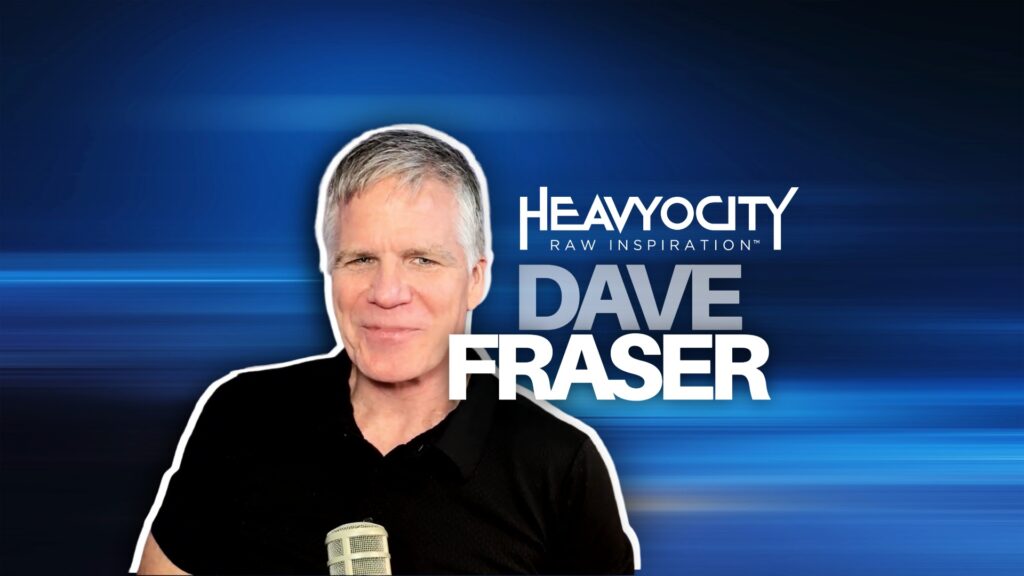
If you spend enough time listening to composers talk about their favorite tools, the name Heavyocity inevitably rises to the surface. Their instruments — from Evolve to Damage, Gravity to NOVO — have shaped the sonic language of contemporary cinematic music. But behind the polished interfaces, processed impacts, and massive hybrid textures lies something far less industrial: a story of friendship, reinvention, and a devotion to sound that borders on spiritual.
Talking with Heavyocity co-founder Dave Fraser feels less like interviewing a software developer and more like sitting with someone who has spent a lifetime learning how to express the invisible. The conversation drifts between philosophy, war stories, technical craft, and the kind of honesty that only comes from someone who didn’t plan on ending up where he did — but followed the work wherever it led.
The Early Shape of a Creative Mind
Before Heavyocity, before touring, before the long arc of reinvention, Dave Fraser grew up in a world defined by contrasts. His father was a physician — disciplined and analytical; his mother, an artist who embraced spontaneity. Somewhere between those poles of structure and freedom, Dave learned to navigate complexity from a young age.
He describes his childhood as a mix of creativity, independence, and quiet challenges that pushed him to grow up fast. He jokes about being “a mischievous kid,” but beneath the humour is the story of someone who often had to find his own way without a clear map.
There was freedom — sometimes more than a child knows what to do with.
There was responsibility — given early and without ceremony.
There were difficult moments — spoken of gently, yet carrying unmistakable weight.
As Dave puts it, “Every family looks perfect from the outside… and it’s never quite what it appears.”
The piano became his refuge long before it became his profession. Martial arts gave him confidence and grounding. Adversity taught him self-reliance. And later, fatherhood reframed everything — softening the edges and deepening his sense of purpose.
Nothing in Dave’s early life pointed directly toward sound design or virtual instruments. Yet everything in it prepared him for the kind of work that demands patience, intuition, emotional depth, and the willingness to rebuild yourself again and again.
His story doesn’t begin with opportunity.
It begins with formation — the quiet, complicated shaping of a person who would eventually reshape how many of us make music.
A Creative Life Built on Detours
Dave didn’t begin as a sound designer. He didn’t begin as a business owner. The arc of his early life reads more like a collection of pivots born out of necessity and instinct.
He grew up playing piano, went to Berklee, became friends with guitarist Neil Goldberg, and eventually found himself touring — living the cliché of “new city every night.” Then life made a sharp turn. A relationship pulled him to Illinois, far from the music industry, where he suddenly had to reinvent himself.
He taught piano lessons. He delivered pizzas. He took odd jobs.
And yet, through all the detours, he kept moving creatively.
A creative life rarely grows in straight lines; it strengthens in the bends.
As he put it:
“Everything that’s part of your story is important.”
That quiet resilience — the ability to stay in motion even when the path disappears — would later become the foundation for everything Heavyocity built.
Heavy Melody to Heavyocity: When Curiosity Becomes Identity
Before Heavyocity became a household name in virtual instruments, Dave and Neil co-founded Heavy Melody, a production studio working on everything from commercials to video games. It was in the cracks of that workload that the seeds of Heavyocity were planted.
Dave started recording his environment with a portable field recorder. Neil contributed raw guitar textures. Ari Winters, then an intern, added more material. A private archive began to form — not as a business plan, but as an instinct.
“We were throwing these raw sources into our labs and screwing them up with all the plugins we had at the time.”
What they discovered wasn’t just interesting sound design. It was a new hybrid aesthetic — one that didn’t yet exist as a commercial product.
The idea crystallized:
What if this became an instrument?
Their first major release, Evolve, emerged from that experiment. And just like that, Heavyocity was born.
The company name? Surprisingly:
A play on Travelocity — chosen because it sounded strong.
The Basement at NAMM: Where Recognition Quietly Begins
When Evolve launched, Heavyocity wasn’t on the main stage of NAMM. They were buried on the basement floor — the “prove you belong here” zone.
But word spread.
Composers found them. Developers found them.
Spectrasonics visited their booth.
Their placement may have been low, but their signal wasn’t.
Evolve hit the market at the perfect moment: composers wanted new textures, trailer music was exploding, and hybrid scoring was entering its golden age. Heavyocity wasn’t chasing a trend — they were defining one.
It was a lucky break, but not an accident.
It was the natural result of following curiosity until it reveals purpose.
The Craft Behind the Chaos
As Heavyocity’s catalog grew, one element consistently separated them from the pack:
the invisible work.
Editing.
Noise reduction.
Round-robin accuracy.
Playback tightness.
Preset curation.
Transition smoothing.
Envelope refinement.
The unglamorous parts of instrument development — the parts most users will never see — became Dave’s obsession.
“Poor editing leads to a bad user experience… I still do a lot of the editing myself because I know how important it is.”
This devotion shapes everything they make.
Heavyocity’s instruments feel polished because someone obsessed over details at a microscopic level. In an age where AI can generate infinite ideas, it’s craftsmanship — not automation — that remains irreplaceable.
When Ideas Become Experiments
One of the recurring patterns in Dave’s stories is that Heavyocity rarely begins with a rigid plan. Instead, they begin with prototypes — proof-of-concepts built before any official greenlight.
A perfect example:
Uncharted 88.
Before any development roadmap existed, the team spent weeks running experimental captures and engine tests just to answer the question:
Can this work the way we imagine?
In Dave’s words, they effectively:
“Built the instrument before they built the instrument.”
This exploratory phase is part science, part intuition. Heavyocity’s signature sound is the result of chasing ideas until they break open — or break down.
Either outcome is valuable.
Both teach them something.
On AI, Tools, and What Will Still Matter Tomorrow
As we explored the future of sound design, the topic of AI inevitably emerged. Dave’s perspective wasn’t fearful or dismissive — it was grounded in the kind of realism that comes from decades of watching the industry reshape itself.
He summed it up with a line that captures the creative survival instinct:
“You latch on — you hold on to the change or you’re going to get dragged.”
For Dave, AI is another technological wave. It will reshape workflows, accelerate certain kinds of tasks, and change the way tools are made. But it won’t replace what makes creators irreplaceable.
During the conversation, I added that while AI can produce impressive results, for now direction and curation still comes from the human behind it:
“AI can generate quality outputs… but knowing what to input requires taste, perspective, experience.”
Between the two perspectives, one truth becomes clear:
For now AI can make very impressive noise — but only humans turn that noise into meaning.
Tools will change, but the creative choices behind them will remain the final frontier.
The Human Message Beneath It All
At the end of the conversation, I asked Dave a question:
“If one message could appear on every phone on Earth, what would it be?”
His answer wasn’t about sound.
Or creativity.
Or technology.
It was about kindness.
“Were you kind and caring towards every person you came into contact with today?”
After hours spent dissecting the philosophical architecture of sound design, we ended on something profoundly simple:
Tools matter.
But people matter more.
A Legacy Built on Devotion, Not Ambition
Dave’s journey makes one thing clear:
Heavyocity wasn’t born from a master plan.
It emerged from a long chain of choices — some deliberate, many instinctive.
It came from:
- curiosity
- reinvention
- experimentation
- invisible labor
- friendship
- and a refusal to stop creating
Their sound has become part of the cinematic vocabulary. But their philosophy is what gives that sound weight:
Follow the ideas that call you.
Care about the details no one sees.
Adapt when the world shifts.
And remain human through it all.
Heavyocity did not set out to redefine hybrid scoring.
They simply cared enough to do the work — again and again — until their devotion became a signature.
And that devotion still shapes every instrument they release.
Prefer Audio or Video?
🔴 Youtube: https://youtu.be/zYMf_ituR00
🟢 Spotify: https://open.spotify.com/episode/2qMdA6GTSVDDK6RnLswNCc?si=tmKkIncGSqqZwPui-AU6dQ
🟣 Apple Podcasts: https://podcasts.apple.com/us/podcast/inside-heavyocity-dave-fraser-on-art-life-and-making/id1528017679?i=1000739276543