Woodwinds as Texture, Motion, and Emotion
There are woodwind libraries you buy to play melodies.
And then there are libraries that make you slow down, hold a chord, and just listen to what’s happening inside the sound.
Primaries / Woods is firmly in the second category.
When I first opened it, I already knew roughly what I was getting into. I’ve been a long-time admirer of Slate+Ash’s approach. Their instruments are rarely about “coverage.” They’re about character. About performance philosophy. About compositional tools. About turning a physical source into something emotionally resonant.
“They really do work that way. And what’s important is that they’re very inspirational compositionally speaking.”
Primaries / Woods continues that lineage — but this time, the raw material is the solo woodwind family: bassoon, clarinet, flute, oboe, and saxophone.
And that choice matters.
Because woodwinds are strange creatures.
They carry air. Resonance. Reed noise. Instability. They sit somewhere between tone and breath. That makes them uniquely suited for hybrid work — you can push them toward synthetic territory without losing their organic identity.
But Woods can do both.
This Is Not a Traditional Woodwind Library
If you’re looking for a flute legato patch to play lyrical melodies over a string bed, this isn’t that.
Primaries / Woods doesn’t try to cover “everything woodwinds can do.” It focuses on specific articulations — often textural, gestural, movement-based — and then builds an engine around them that encourages exploration.
You don’t open this library to orchestrate a Mozart passage.
You open it to build atmosphere.
To create motion inside sustained harmony.
To shape emotion without obvious melody.
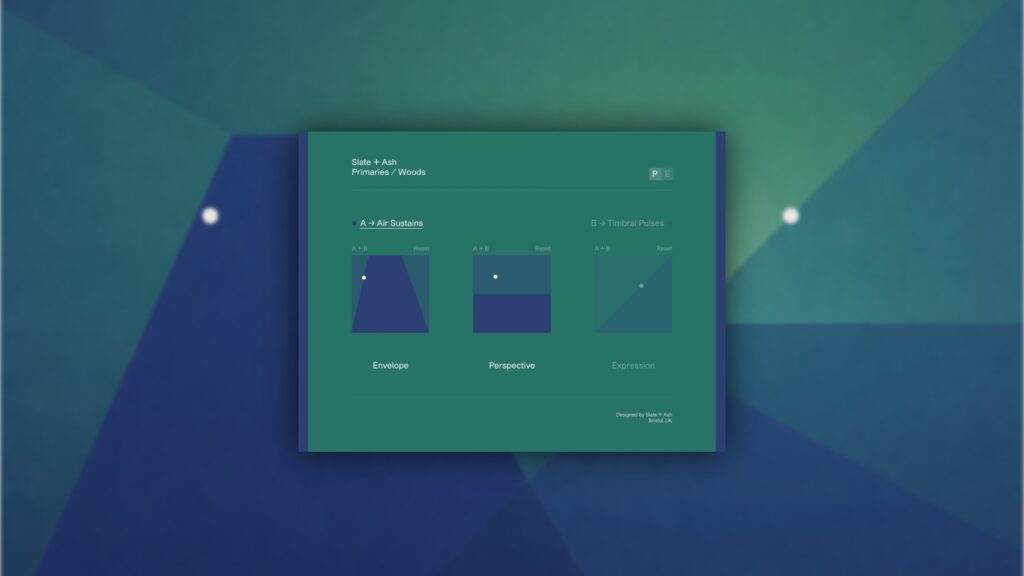
The Engine: Where Things Start to Get Interesting
On paper, Slate+Ash’s engine looks minimal. Almost too minimal.
But once you begin moving through it — adjusting perspective, blending spatial layers, nudging expressions — you realise it’s less about obsessive tweaking and more about flow and inspiration.
One of the most compelling aspects is how space is treated. The woodwinds were re-amped and processed through multiple environments and hardware, giving you spatial characters you can blend and reposition. Instead of a static “room mic,” space becomes part of the compositional vocabulary.
And because woodwinds already carry breath and texture, these spatial transformations don’t feel like an afterthought. They feel like part of the instrument’s identity.
“It is really made for composers.”
Where It Really Comes Alive
As I moved through the Sound Design folders — Arps, Atmospheres, Keys, Motion, Pads, Textures, Primary — a pattern emerged.
A lot of this library lives in the in-between.
Between acoustic and synthetic.
Between pad and performance.
Between stability and instability.
The Keys category, unexpectedly, was a highlight. Woodwinds combined with lo-fi tape aesthetics — wobble, flutter, air, subtle breakup — just works. The air inside the tone interacts beautifully with tape-style modulation. It’s the kind of pairing you don’t realise you needed until you hear it.
The Motion patches felt big. Ready. Some of them sit right on that edge where you think, “This could just as easily be a synth,” but then you hear the organic detail inside the texture and realise that’s what makes it compelling.
“How big.. how READY does that sound!?”
The Pads lean heavily into ambient territory. Slow harmonic movement. Emotional depth. A kind of warmth that doesn’t feel overly polished. Some of them are slightly unruly — in a good way. Alive.
And then there are the Textures and Primary folders — variations within a shared aesthetic space. This is something I personally value. When I’m writing, I often don’t want radically different directions. I want multiple shades of the same emotional colour so I can find the exact one that locks into the cue.
This library gives you that.
The Articulations Themselves
When you drop down into the individual instruments — bassoon, clarinet, flute, oboe, sax — the sampling quality is immediately apparent.
Low material stays clear instead of muddy.
Layering feels natural instead of synthetic.
Gestural articulations retain realism even when stacked.
“It’s a beautiful, beautiful sound.”
There’s a raw openness to the sampling, but it never feels thin — it’s full, grounded, and unmistakably human. The saxophone, in particular, is noteworthy. Sax sampling can easily go wrong. Here, it feels controlled and believable within the library’s aesthetic.
And then there’s the Expressions system — moving from sustain into shivers, fractures, circular gestures via the mod wheel. On paper, it sounds simple. In practice, it’s surprisingly musical. It completely avoids the cheap crossfade feel that many dual-layer systems suffer from. Instead, it behaves like a living texture evolving under your fingers.
That’s not trivial.
The Emotional Core
If there’s one word that keeps surfacing when using Primaries / Woods, it’s this:
Emotion.
Not dramatic bombast.
Not flashy orchestration.
But subtle emotional shading.
“It’s very rare to get this level… of emotion out of an orchestral library.”
It’s very difficult to get this level of emotional nuance out of orchestral sampling unless the performances were designed with that intention from the start. And here, you can feel that intention.
These aren’t generic sustains.
They’re performed gestures. Specific shapes. Physical exchanges between breath and instrument.
That makes a difference.
Limitations (By Design)
Because this library is so focused, it naturally excludes things.
It doesn’t aim to be your all-purpose woodwind solution. It won’t replace a traditional orchestral library. It’s not trying to.
And the preset count, while solid, leaves me wanting more — not because it is outright lacking, but because Slate+Ash’s sound design is so strong that I simply want more of their taste packaged as starting points.
That’s a compliment disguised as criticism.
Who This Is For
If you write:
- Slow, textural orchestral music
- Ambient or soundscape-driven material
- Hybrid scores that blur organic and synthetic
- Emotional underscore that avoids obvious melody
…then Primaries / Woods should absolutely be on your radar.
If you’re writing classical woodwind lines, look elsewhere.
Final Thoughts
There are very few companies right now that handle orchestral texture as well as Slate+Ash.
Primaries / Woods continues that reputation. It takes woodwinds — often overlooked in modern sampling — and treats them not as melodic tools, but as emotional matter.
Breath.
Friction.
Air.
Motion.
And then it gives you an engine that lets you shape those qualities into something uniquely yours.
It’s not a library about playing notes.
It’s a library about shaping feeling.
“I don’t think there’s any company on the planet right now that does orchestral texture better than Slate+Ash.”
Get it here – https://slateandash.com/products/primaries-woods
Prefer Video?
🕵🏻♂️ Deep Dive: https://youtu.be/p0lxklDDiFE
🤫 ‘No talking’ Demo: https://youtu.be/9EoY8c6MjGE