A raw cinematic sample library for hybrid scoring, percussion, gritty strings, and performance-based loops.
PRIMAL doesn’t try to be polite. It isn’t lush, pastoral, or polite-legato cinema. It is built around bow rasp, wooden resonance, metal collisions, gravelly breath, and physical energy.
“It is raw. It is gritty. It is organic. It is Primal for sure.”
A lot of products approach “raw” through processing, while PRIMAL achieves it through performance, resonance, and recording choices. PRIMAL delivers performers hitting, scraping, bowing, bending, and growling into microphones until the audio turns into physical storytelling.
That’s the core appeal here: music built from organic friction.
“If this is the type of sound you’re after, this is a no-brainer — insta-buy.”
An Aesthetic That Knows Exactly What It Wants
PRIMAL focuses on texture, physicality, and performance detail rather than traditional orchestral polish. It delivers playable material with grit, bow noise, and varied resonance, which helps it sit comfortably in hybrid and modern scoring. Importantly, it isn’t locked into a “Viking” or medieval stereotype—the sounds work just as well in thriller underscore, ambient tension, hybrid action, or even industrial-leaning cues.
“This can supplement so many different styles of music.”
Interface and Workflow — Fast, Familiar, and Score-Ready
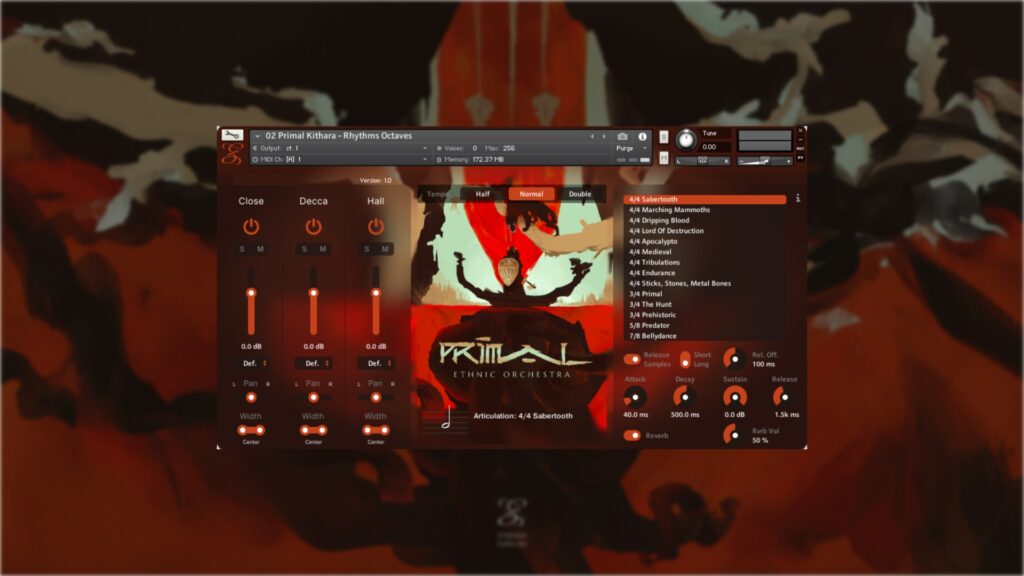
The Kontakt interface follows Strezov’s recent design philosophy and is built for speed. The three mic positions—Close, Decca, and Hall—offer a genuinely usable spectrum rather than a token spread. The Close position isn’t clinically dry; it delivers a full sound that anchors the instrument. Decca adds natural width and noticeable reverberation, while the Hall pushes the sound deeper into the room with a smooth, realistic ambience. In practice, that makes it easy to shape a cue from distant and atmospheric to forward and aggressive simply by shifting emphasis from Hall to Close. The ambience is natural, progressive, and immediately mix-ready.
Strings — Bow Noise Is a Feature, Not a Bug
Strings in PRIMAL aren’t chasing Abbey Road elegance. They’re chasing fiber and torque.
PRIMAL includes a dedicated orchestral string component recorded specifically for this library, and the material isn’t aimed at lush concert hall beauty. Strezov went in with downtuned scordatura sections and solo chairs, captured across multiple articulations, dynamics, and round robins. That decision wasn’t cosmetic — it was about weaponizing orchestral string texture.
Scordatura tuning alters open-string pitches and resonances so that certain aggressive, open-string combinations become practical to play and sonically distinctive, helping the instruments deliver a darker, more resonant timbre that suits gritty cinematic textures. Instead of smoothing that out, PRIMAL embraces it. The result gives the strings a level of grit and bite rarely heard in commercial libraries. They can stand alone for full-tilt, abrasive string writing, but they’re just as effective layered under existing libraries when a cue needs extra weight, attitude, or low-mid punch.
Having soloists available pays off musically. It lets you control texture and intensity—use the full sections for thicker agitation, or switch to first chairs when a more exposed sound is needed. That structure makes it easy to dial in the level of tension and detail.
One of the strongest assets here is the bass register. The low strings carry striking texture, bite, weight, and grain, with a slightly unhinged resonance that suits modern scoring—especially pulsing ostinatos, tension cues, and dark textural beds. It’s easily one of the library’s most distinctive features: a low end that growls and thrashes instead of behaving.
“They have so much presence and focus that even in the deep low end you can still actually hear pitch quite recognizably. Just standing ovation for the strings — especially the basses.”
Percussion — The Crown Jewel
PRIMAL’s percussion is where the attitude turns up. Although Strezov frames the library around Nordic and medieval themes, the actual rhythmic palette is far more expansive. The instruments feel global in scope, and the grooves range from Arabian-leaning phrases to African-style patterns, from snare-march energy to ominous tribal warfare. However its real staying power comes from modular design—the material can change character instantly depending on what you layer it with.
“Imaging S-tier, mixing S-tier, tracking S-tier, texture S-tier.”
The engine encourages:
- stem-separated loop building (high/mid/low)
- compositional modularity built on deeply engaging but uncomplicated rhythmic patterns
- natural, performance-based loops that breathe with organic expression but never drift into looseness or flatness
The sonic verdict is unambiguous:
the percussion lands in S-tier territory.
But the brilliance doesn’t stop at the loops. The same sound sources are available inside the X3M engine as playable hits, which makes the package even more attractive. You can build custom kits from those elements or use them to reinforce and customize the loops whenever they’re not delivering the exact movement or accents you want.
Percussion, Built for Speed
The X3M rhythmic engine remains one of Strezov’s most composer-friendly choices. It lets you assign sounds freely across the keyboard and stack favorites into a custom kit within seconds. The whole design prioritizes modularity and speed, giving you flexible percussion without procedural friction.
“You can pick each individual element from those loops — so you can build the kit yourself or supplement the loops themselves.”
One limitation seems to be the fixed six-slot layout for instrument zones. Allowing users to resize those zones would make keyboard mapping far more efficient—especially for finger-drummers who rely on tighter groupings. And while the engine supports creating and saving user presets, a collection of factory presets would go a long way. Curated starting points would speed up familiarization, highlight what each patch can do, and offer instant inspiration without manual setup.
A standout in the percussion section is the Basement Tube—four octaves of steel-toned resonance that handle everything from percussive accents to dark-ambient and horror-style drones without hesitation. It’s a rare atmospheric tool with enough range and character to earn a permanent place in cinematic scoring.
“Absolutely stellar sounds. I love when weird objects are sampled for percussive needs.”
Performance Rhythms — Human Timing as Musical Ammunition
Several instruments include a Rhythms version, where they perform repeating patterns rather than triggering isolated notes. They don’t merely imitate organic timing—they are organic, because the patterns were actually played by musicians, then chopped and mapped without sanding away the human imperfections.
That micro-timing is crucial. It keeps the material feeling alive instead of synthetic or grid-bound.
These Rhythms patches also follow the same pattern structure used in the percussion loops, which means you can:
- sketch themes quickly with percussion loops
- stack hard-hitting rhythmic layers on top of each other
- work faster because you recognize the timing vocabulary
It’s a smart ecosystem—different instruments speaking the same rhythmic language, ready for instant momentum.
Sparks — Cinematic Pads That Pull Double Duty
Sparks remains one of the strongest components of PRIMAL. Instead of generic pads or washed-out ambience, it offers polished, screen-ready atmospheres built from organic, percussive, and synth elements. Each patch provides three blendable layers, giving you quick tonal control without extra routing.
“They are so good, I would buy that library on its own. If they gave access to individual elements, it would be absolutely amazing.”
The limitation is flexibility, not quality: the individual elements you hear aren’t fully isolated as editable layers, so you can’t fine-tune a custom internal mix to the level some composers may want. That said, the presets themselves are stunning—immediately usable, mix-friendly, and happy to sit alongside other instruments.
In short, Sparks isn’t built for deep sculpting. It’s built for fast, convincing cinematic atmosphere with minimal effort.
Other Instruments — Character, Not Convention
PRIMAL includes several atypical, rare, forgotten, and even ancient melodic instruments that provide tones that sit somewhere between traditional performance and sound design. A few standouts:
Rusty Saw: A highlight thanks to its wide articulation range and expressive, gritty character. It delivers bow noise, harmonics, slides, guttural sounds, and dynamic swells rarely found in similar stringed instruments, and pairs well with other strings when you want more grit and texture.
“This Rusty Saw instrument… could be one of my favorite instruments, period.”
Aeolian Fan Harp: A stunningly unique-toned instrument that lands somewhere between steel-string guitar, piano, celeste, harp, zither, and even chimes. It can sound calming, ethereal, or slightly eerie depending on context. One of my favourites.
“A stunningly, stunningly beautiful instrument — beautifully sampled — could play that for hours.” (Aeolian Fan Harp)
Kithara: A lyre-style instrument with strong resonance and percussive attack—useful for adding organic rhythmic motion or light string grooves.
Arrow Monochord: An ancient single-string instrument with a melancholy tone that works well in atmospheric and tension scoring.
Didgeridoo: Experience with sampled didgeridoos may vary, but this is easily one of the strongest implementations available. Many libraries make the instrument sound thin, synthetic, or hollow. In PRIMAL, it lands with natural weight, presence, and low-end power—more like a physical instrument recorded in a room than a processed monstrosity.
“Some of the ones I’ve heard sound synthetic — they can’t capture the visceral presence. They perfectly capture that here.” (Didgeridoo)
These instruments exist to provide extremely unique character rather than orchestral coverage—strong as featured colors, and equally effective as textural layers in hybrid scoring.
Vox & Human Elements
The vocal content—shouts, stomps, and rhythmic syllables—fits naturally into PRIMAL’s physical aesthetic. Strezov’s track record with vocal and choir sampling is well established, and this material follows suit. The voices have real power, grit, and weight, making them ideal when a track needs aggressive human energy or masculine authority.
The collection isn’t enormous, but it’s flexible, thoughtfully curated, and covers the essentials for adding rhythmic vocal impact and texture without getting in the way.
Stylistic Reach — Broader Than Expected
Although PRIMAL is marketed as “tailored towards a gritty, nordic, medieval sound,” it’s not boxed into Viking or folk clichés. The library simply excels at rustic, physical energy, and that translates into a wide range of scoring contexts. The rhythmic content and textures adapt easily to thriller underscore, hybrid cinematic work, ambient tension, or any situation where raw, physical tone adds value.
“It pairs superbly with a lot of other instruments — not locked into any one category.”
Verdict — Physical Sound for Physical Storytelling
PRIMAL succeeds because it understands storytelling through texture, friction, and resonance.
It delivers:
- percussion that rattles, grooves, hits, and pulsates
- rhythmic material built on real human timing
- gritty strings with bite and texture instead of smooth gloss
- uncommon instruments that add organic darkness and edge
- winds that buzz and rattle rather than whisper politely
- soundscapes that can carry an entire cue with a single note
It’s a cinematic toolkit for composers who want pressure, dirt, and physical energy inside their arrangements — not another polite orchestral coat of paint.
“Anyone working in orchestral or cinematic music should have a look at this.”
🎛️ Get PRIMAL here: https://www.strezov-sampling.com/products/view/primal-ethnic-orchestra
Prefer Video?
📺 Full Review: https://youtu.be/70XKU7S_IL8
🤫 ‘No Talking’ Demo: https://youtu.be/0swSXBnHFog
🎛️ Editorial Product Review: https://youtu.be/yQoqIB1yWDQ