There’s a difference between recreating retro game sounds… and recreating why they mattered.
Super Audio Cart 2 by Impact Soundworks isn’t just a pile of 8-bit waveforms. It’s not a chip emulator in disguise. And it’s not a “lo-fi gimmick” instrument for throwing pixel dust on modern tracks.
What it actually is — and this becomes clear very quickly — is a deeply curated, sampling-based archive of console identity.
This library is built from over 6,000 sampled sources spanning nearly twenty classic systems — from Commodore 64 and NES to Nintendo 64 and PlayStation — and it runs inside Kontakt Player. It’s exhaustive in scope. But more importantly, it’s attentive to character.
And that’s where this thing wins.
What This Is — and What It Isn’t
Let’s set expectations early.
This is a sampling-based instrument. Not modelling. Not algorithmic chip recreation. These sounds were painstakingly recreated and, in many cases, played back through original hardware to capture the right coloration.
That means you’re not programming waveforms from scratch.
You’re playing instruments.
But here’s the key: these aren’t “inspired by retro” sounds. They’re deeply platform-specific. Everything is organized by console or sound chip. If you want Commodore 64, you load C64. If you want Game Boy Advance, you load GBA.
That makes this library extremely authentic.
It also means this isn’t a modern preset-driven sound design playground in the traditional sense. There aren’t polished, hybrid “mega patches” combining sources across platforms in pre-built cinematic presets. You’re working at the source level.
Personally, I see both sides of that.
If you’re serious about era accuracy, this is brilliant. If you just want instant inspiration without caring which chip it came from, you’ll need to dig.
But dig is the right word — because what’s here is worth digging into.
The First Reaction: “Why Does This Sound So Good?”
I’ve played a lot of retro recreation libraries.
And one of the biggest issues with this genre is harshness. Brittle top end. Fatiguing square waves. Lo-fi without warmth.
Super Audio Cart 2 avoids that trap.
From the very first C64 drums, it was obvious:
“I mean, yeah, that’s super super juicy.”
That word — juicy — kept coming back to me.
The kicks from the NES? Dusty, warm, thick — but still clean.
The Game Boy leads?
“It’s just so gritty, crispy… it stays crispy clear.”
The Genesis drums? Aggressive but full.
The PlayStation pads? Surprisingly lush.
This is the balance that’s hard to get right. Retro hardware often feels warm in memory because we heard it through TVs, through analog chains, through imperfect speakers. Capturing that authentic signal without turning it brittle is tricky.
Here, across the board, the sounds feel full, clear, and somehow sparkling.
“These are probably some of the best sounds in this style and genre that I’ve heard.”
That’s not nostalgia talking. That’s tone.
Game Boy Advance — The Unexpected Star
I’ll be honest. I didn’t expect to be floored by Game Boy Advance. Even as a BIG Advance player back in the day, I wasn’t expecting to be this deeply captured by this folder.
I was wrong.
The GBA section is rich. And not just in quantity — in personality. There’s grit in the noise profile. There’s this tactile, almost semi-real sampled quality in certain patches that crosses into something more emotional.
“That is stunning. Just beautiful. Period.”
And that wasn’t hyperbole.
Some of these patches don’t just sound like retro game assets. They sound like instruments that happen to live inside a retro constraint.
There’s something about the noise character — the subtle detuning, the imperfect sampling resolution — that makes them feel alive. Not harsh. Not brittle. Alive.
Architecture & Engine — Functional and Focused
Under the hood, the engine is straightforward but powerful.
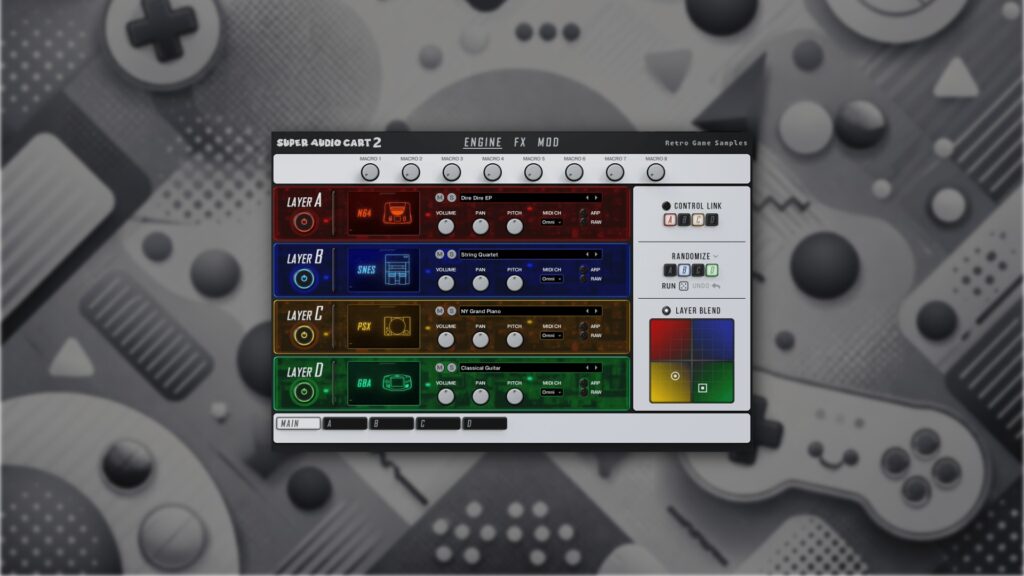
You get four layers. Each layer can load a console-specific source. You’ve got per-layer ADSR, filter, velocity control, pitch range, mono/legato, and keyboard splits. There’s an arp page (solid, flexible, fun), per-layer FX plus master FX, and a modulation matrix (“Modrix”) that gives you envelopes, LFOs, steppers, velocity routing — all the essentials.
Nothing feels gimmicky. Nothing feels over-engineered.
But I do wish there were more pre-built hybrid presets combining sources in creative ways. The raw material is phenomenal. Hearing what the developers would do with cross-platform layering would be inspiring.
Still, even without that, the workflow is clear. Logical. Direct.
The arpeggiator in particular is just pure fun.
“Yeah, actually this is a ton of fun. I always love arpeggiators.”
You can get lost quickly in 8-bit rhythmic patterns.
Emotional Impact — The Real Test
The real test of any instrument isn’t specs.
It’s whether you want to write music.
And repeatedly throughout this session, I caught myself saying things like:
“This just makes me want to start writing a soundtrack.”
That’s the highest praise I can give.
Because retro sounds are easy to caricature. They’re harder to internalize emotionally. When they work, they don’t feel like novelty — they feel like a legitimate tonal language.
There were multiple moments — especially in the N64 and PlayStation sections — where I stopped thinking “retro” and just thought:
This is a beautiful sound.
“Just forget retro video game sounds. It’s just a beautiful sound.”
That boundary-crossing quality surprised me.
This library isn’t boxed into chiptune or nostalgia territory. It’s just as usable in lo-fi hip-hop, indie scoring, hybrid orchestral layers, or subtle texture design.
Scope — Massive, But Coherent
Covering nearly twenty systems means this thing is broad.
Commodore 64.
NES.
SNES.
Genesis.
Game Boy.
Game Boy Advance.
Nintendo 64.
PlayStation.
Adlib.
SampleCell.
And more.
That could easily become bloated.
But because everything is platform-organized, it stays coherent. If you want to stay era-true, you can. If you want to cross-pollinate between chips, you can.
And because everything lives in Kontakt Player, integration is painless.
Some folders are surprisingly compact, but that’s simply the nature of sampling extremely simple sound chips. There’s only so much raw material those systems could produce. Could certain categories be expanded further? Perhaps. But what’s here more than covers the essentials — and in many cases, goes well beyond them. Personally I prefer seeing quality over quantity.
The Big Question — Is It Worth It?
At around $199 full price, the question becomes: who is this for?
If you occasionally sprinkle a square wave into cinematic scores, maybe not essential.
If retro is a central language for you — absolutely.
If you’re scoring pixel art games.
If you love the tonal identity of specific consoles.
If you want authenticity without legal gray zones.
If you care about noise profiles and chip character.
Then yes.
Because the one thing this library consistently gets right is this:
These samples make me want to write music. They’re full, juicy, and filled with vibe.
Final Perspective
Super Audio Cart 2 isn’t flashy.
It doesn’t scream.
It doesn’t over-design itself.
What it does is deliver a very comprehensive, authentically sampled archive of retro game sound that somehow manages to feel warm, crisp, full, and emotionally usable in 2026.
It respects the hardware.
It respects the era.
And most importantly, it respects tone.
If you live in this world — or even visit it often — this isn’t just nostalgia.
It’s a serious instrument.
Get it here: https://impactsoundworks.com/product/super-audio-cart-2/
Prefer Video?
Full Deep Dive: https://youtu.be/Bxqi-J_2kn4
‘No talking’ demo: https://youtu.be/YQzj32zy-6c