There are sample libraries that give you sounds, and there are sample libraries that give you a place to explore. Morphology Evolved, the updated Kontakt edition of Zero-G’s long-running Morphology series by sound designer Ian Boddy, belongs firmly in the latter camp. This isn’t a library you load up to check boxes on an orchestration template. It’s the kind of instrument you sit with — exploring, layering, following where the textures lead — and before you realize it, you’ve written something you wouldn’t have arrived at any other way.
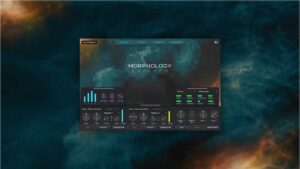
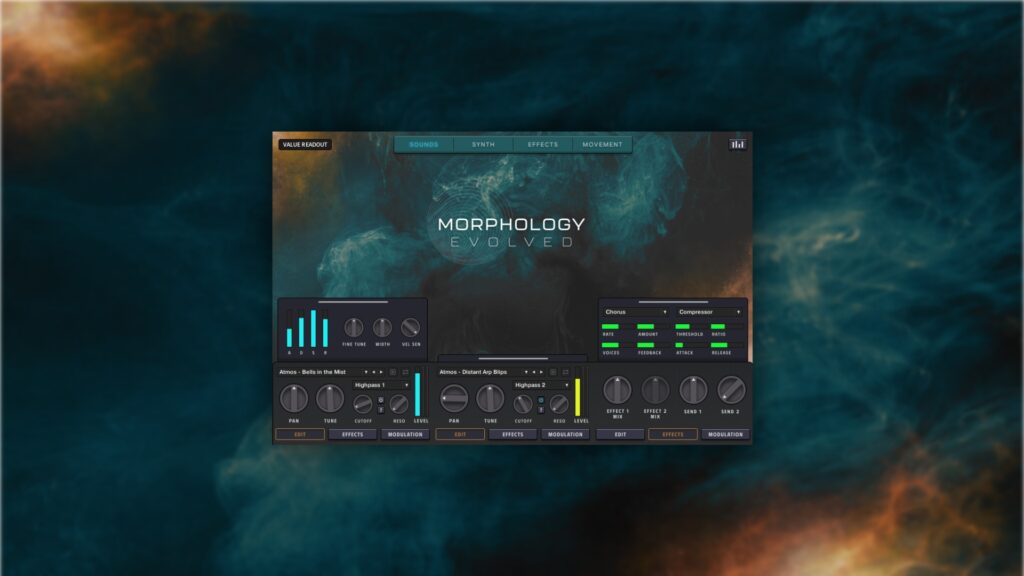
That distinction matters, because it shapes who this library is for and how you should approach it. If you’re looking for orchestral hits, drum kits, or bread-and-butter instrument patches, Morphology Evolved is not the tool. What it is — and what it does remarkably well — is offer a carefully curated world of evolving soundscapes, analog-rooted synth textures, ambient atmospheres, and sound-design material built from Ian Boddy’s decades-long archive of vintage and modern synthesizers. The library runs on the Orbiter engine within Kontakt 8.3 or higher (full version required, not the free Player), and its architecture offers three sample layers plus a wavetable synthesizer, with an XY morph pad for blending between them. Each layer gets independent filters, tuning, panning, modulation, and effects — a straightforward system, but one where the real magic comes from the 301 source samples Boddy created using instruments like the Minimoog, Roland System 100M, EMS VCS3, and modular systems from Analog Solutions and Doepfer.
Morphology Evolved is also the first release in what Zero-G is calling the Evolved series — a broader initiative to revisit their classic sample libraries and reimagine them through modern synthesis and performance tools. It’s an approach I find genuinely compelling. As creatives, we accumulate a huge body of work over the years, and too much of it gets left behind rather than reconsidered. The original Morphology recordings remain at the core here, but the engine, the effects processing, and the morphing architecture are entirely new. It’s not an update — it’s a rethinking, and the result feels like a library that honours its source material while opening it up to a completely different set of possibilities. Heavy Industry Evolved and Ambient Soundwear Evolved are next in the series, with more planned for 2026.
The Ambient Heart of the Library
The first thing that struck me while working through the presets — and I did go through every single one of them, blind, with no prior listening — was a quality I can only describe as beautifully curious. Many ambient and texture libraries tend to settle into one mood — oppressively dark, or relentlessly ethereal, or self-consciously cinematic. Morphology Evolved carries a different tone. There’s an otherworldly calm to much of its content, but it’s threaded with a gentle strangeness, a sense that the sound is arriving from somewhere unfamiliar. It’s calming and alien at the same time, and that combination turns out to be incredibly compositionally fertile.
“These ambient elements are by far my favorites in here. They’re just beautiful, ethereal… calmly otherworldly. You can hear something kind of alien — and it’s going to be strange — but it has a calming effect.”
The evolving textures and atmospheric presets form the emotional core of the library. They inhabit a space that feels subtly nostalgic — there’s a tint of the late ’90s and early 2000s in some of the timbres, not so heavily that it becomes era-specific, but enough to give the material a particular character. In practice, this turns out to be surprisingly useful. If you’re scoring sci-fi, for instance, introducing something with a slightly older sonic signature into a futuristic world creates a sense of temporal displacement — different era, different universe — that’s difficult to achieve by other means.
“They do hint at their time of generation… this has that kind of ’90s, early 2000s thing. It’s not so strong that it would get in the way of doing something else, but it does have a bit of a tone like that. I think that can be super useful with a lot of different goals.”
Sound Design and the Movement Page
Morphology Evolved includes a Movement page — a system designed to generate motion and textural shifts through automated layer changes — and I expected it to be the headline feature. Interestingly, not every preset in the library actually utilizes it. While surprising, it doesn’t feel like an omission. The presets that do engage the Movement page demonstrate its potential clearly: it’s genuinely effective for motion-based soundscape work, cycling through layers in ways that feel organic rather than mechanical. For presets that don’t use it, the material simply doesn’t need it — the samples themselves carry enough internal evolution to stand on their own. The Movement page lives or dies not just by its automation pattern, but by the combination of samples you’ve chosen across the layers — the two are inseparable.
The sound design folder is where the library shows one of its particular strengths: restraint. Glitchy, textural sound design can so easily tip into territory that’s either underwhelming or overwhelming, and the material here navigates that balance with real maturity. There’s a thoughtfulness to how the presets move through their timbral changes — never erratic, never static.
“When you’re doing glitchy but interesting sounds, it can easily be underwhelming or just too much. I think this has a very nice, mature sense of moving through these different glitchy sounds.”
The source samples are also sonically transparent in the best sense. You can quickly identify which layer in the preset is contributing what, strip away what you don’t want, and build from what you do. That kind of clarity isn’t always a given in texture libraries, and it dramatically reduces the time from “browsing” to “composing.”
The Surprise: Pads and Synths
Given how pad-like much of the material in other folders already feels, I wasn’t entirely sure what the dedicated Pads and Synths section would bring to the table. The answer is: more textural variety than you might expect, and some genuine surprises. The pads themselves blur the line between sustained tones and evolving textures — the categorization here is loose enough that it’s worth exploring without assumptions about what belongs where. But the real revelation was the synth content. The analog patches are remarkably full, punchy, and well-balanced, with some of the plucky, short-note sounds carrying a snappy, puffy character that feels immediately playable — less soundscape, more pure musical satisfaction. I didn’t expect to find that here, and it’s one of the strongest arguments for spending time with every corner of this library. Many of the synth patches double as convincing classic analogue tones — and some veer into delightfully blippy, bloppy retro-gaming territory.
“How good are these analog lead synths? These are superbly good… super full, nicely balanced. I did not expect that at all based on the description.”
The effects processing across these patches deserves particular mention. It’s subtle — not heavy-handed reverb tails or saturated delays, but gentle, deliberate treatments that place each sound in exactly the right acoustic context. The effects feel less like additions and more like a natural extension of the samples themselves.
“The effects are very light, but very elevating. It’s just a tad bit that gives a nice amount of space and support.”
There’s also a quality to the harmonic content that keeps things interesting without destabilizing a composition. Some of the overtones subtly skew the harmony — not enough to pull dominantly away from the established tonality, but enough to create what I’d call a gentle tickle on your sense of what’s happening. It’s the kind of controlled unpredictability that makes you want to explore further rather than reach for a different preset.
Composing With It
What ultimately distinguishes Morphology Evolved as a compositional tool — rather than just a sound source — is how it interacts with your own musical thinking. The presets are built with sufficient simplicity and modularity that you can harmonize with them (to varying degrees, most of the time), layer them, and build around them without fighting the material. If you understand what a preset does at one pitch, you can anticipate how it’ll behave at a fifth or another interval, and that predictability becomes a creative asset rather than a limitation.
“They are actually built with sufficient simplicity and modularity in mind that you can do things with it… it takes you to places that are compositionally refreshing and unexpected. It encourages exploration and trying all kinds of things.”
This is where Ian Boddy’s experience as a composer — not just a sound designer — really shows. The samples aren’t arbitrary textures thrown into a sampler. They’re musical materials with internal logic, and that logic invites you to compose with them rather than simply over them. The library consistently led me toward ideas I wouldn’t have found on my own, which is about the highest compliment I can pay to any creative tool when it comes to compositional inspiration.
Wavetables and Minor Criticisms
The wavetable folder rounds out the library with glitchy, grinding, bitey content that feels distinct from the other categories. It’s a smaller section and operates purely through the wavetable engine rather than the layered sample pages, but there’s genuinely useful material in here — particularly for anyone working in experimental or digital-destruction territory. One of these presets immediately sparked the thought that a full orchestral library built in this broken, digitized style would be extraordinary.
The source sample browser could benefit from jumping directly to the selected preset’s sample rather than always starting from the top of the list. This is a minor workflow inconvenience rather than a substantive issue, but it does definitely influence the workflow.
The library isn’t massive in terms of raw preset count or source samples — 100 snapshot presets drawn from 301 original recordings across 3.11 GB — but it isn’t trying to be, and the price reflects that. At $59.95 full price ($41.95 during the introductory period, or just $19.95 if you’re upgrading from the original Morphology), the content feels well-balanced rather than thin. I would have liked to see a few of the preset categories more fleshed out, but it’s worth keeping in mind that presets are just starting points. They don’t define the boundaries of what the engine can actually produce once you start shaping your own pads, textures, or whatever else you’re after.
Final Perspective
Morphology Evolved is a library that rewards patience and curiosity. It’s not going to drop a ready-made cue into your timeline, and it’s not trying to. What it offers instead is a deeply personal collection of analog-sourced textures and synth sounds that carry a distinctive sonic fingerprint — something between ethereal calm and quiet strangeness, with a surprising depth of playable synth material underneath. Almost every synth preset in here was a home run for me, and that’s not something I expected going in. If you work in ambient music, dark ambient, film scoring, experimental composition, or any context where atmosphere and texture are primary rather than incidental, this belongs on your radar. Ian Boddy’s sampling taste and decades of experience are audible in every preset, and the library consistently does what the best creative tools do: it makes you want to sit down, explore, and write.
“The punchiness of them, how visceral these are — really speaks volumes about Ian’s sampling here.”
Get it here: https://zero-g.co.uk/products/morphology-evolved
Prefer Video?
⚡️ Editorial Spotlight: https://youtu.be/JSD-vpwq3Ds
🕵🏻♂️ Full Deep Dive: https://youtu.be/q_WxtgMCP9c
🤫 ‘No talking’ Demo: https://youtu.be/Vd5g7l67M94