There’s a concept at the heart of Haunted Spaces 2 that I find genuinely compelling: the idea that past events leave a charge in the atmosphere of a place. That’s the philosophy of field recordist Chris Watson, whose work forms the sonic foundation of this Soniccouture instrument — and it’s the kind of thinking that elevates a sample library from being merely useful to being something you actually want to spend time inside.
I’d been circling Haunted Spaces for years. The original had a strong reputation among composers working in ambient and sound design territories, and more than once I nearly pulled the trigger. The only thing that stopped me was not having an immediate project to put it to work on — and I tend not to buy things I can’t use right away. So when the opportunity came to check out version two, I jumped at it — and went in completely blind. No preconceptions, no muscle memory from the first version. Just ears.
What I found was one of the most inspiring instruments I’ve encountered in a long time.
What This Is — And What It Isn’t
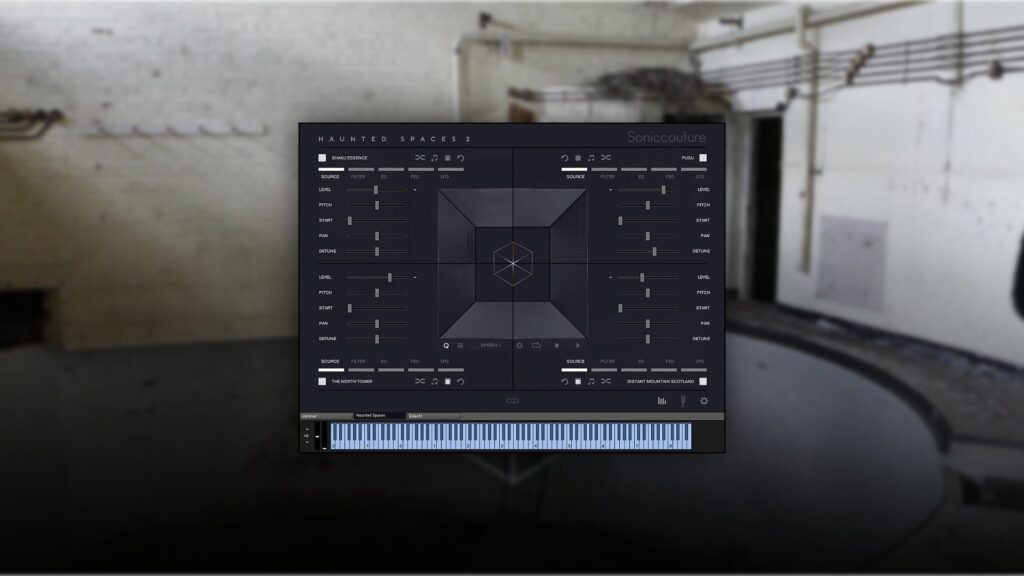
Let me set expectations. Haunted Spaces 2 is not a traditional orchestral library. It’s not a synth, either, though it has synth elements. At its core, it’s a hybrid instrument built around Chris Watson’s field recordings — 178 of them, with 50 new additions in V2 — layered alongside 240 Soniccouture sample sets drawn from sources like the Ondes Martenot, Novachord, bowed piano, and various custom sounds. All of this feeds into a four-point vector control called the Cube, which lets you morph between four waveform sources simultaneously. There’s also a Jammer — essentially a pattern and arpeggiator system — plus a full effects page. The whole thing runs in Kontakt Player 7 or 8, so you don’t need the full version.
“It’s like a toy box in which I’m jumping into and I can see things that I want to pursue and follow.”
At around 9 GB, the footprint is surprisingly small, which makes sense when you consider that field recordings don’t carry the same multi-velocity, multi-dynamic sampling overhead as, say, a string library. That compact size also translates into something I genuinely noticed during the session: everything loads absurdly fast. I know the engine is only pulling in four waveform sources at a time, but compared to a lot of Kontakt libraries, the speed is striking enough to be worth mentioning.
Pricing sits at €199 full, with an introductory offer of €139 running through May 11, 2026. If you already own the original, this functions as a paid update rather than a separate product — Soniccouture appears to have folded the V1 content into V2, which is a slightly unusual but welcome approach. Users of Haunted Spaces 1 can upgrade for $79 for a limited time (the euro equivalent may differ — check your account); log in to your user account to see the offer. There are also optional sound packs from designers like Ian Boddy and Sound Design Team K/V, though pricing for those is only visible once you’re logged in — a slightly odd but minor transparency gripe.
The Recordings Are the Foundation
I want to be direct about this: the field recordings in Haunted Spaces 2 are extraordinary. Watson’s material spans Cold War research bases, abandoned mines, ice lagoons, Aztec ruins, hydroelectric stations, Norwegian mausoleums, caves in Borneo, tunnels in Pamplona — the specificity alone is remarkable. But what makes them genuinely special is their sonic character.
“The field recordings are stupid good.”
There’s a tangibility to these recordings that’s rare. They’re visceral and tactile without ever feeling pushed or over-processed. The low-end presence is immense — it establishes a soundscape immediately — while the upper registers carry beautiful air and noise without becoming harsh. Not once during my entire session did anything feel out of balance.
“All the elements hybridize into this one super coherent sound that you just perceive as being one sound. Nothing is missing. Nothing is too much.”
If you make any kind of music that incorporates field recordings and ambiences, these source sounds alone would justify the purchase. Even if the engine did nothing else, the quality of this material puts Haunted Spaces 2 firmly in the conversation.
Where It Surprised Me
I expected the soundscapes and pads to be the main draw, and they absolutely deliver. The soundscapes cast a remarkably wide net — from ominous and dark to calm and shimmering — and the pads extend that range with more overtly synth-influenced textures. Soniccouture has conveniently subcategorized the presets into calm, noisy, and ominous, which is a thoughtful touch for browsing.
But the real surprises came elsewhere.
The Radiophonics category is packed with electro-mechanical textures — the kind of sounds that are genuinely hard to find in sample libraries. If you work in noisier genres or need that sort of gritty, electrical-industrial palette, this section alone is worth your attention.
“That is like dark ambient perfection.”
The leads caught me completely off guard. I’d assumed they’d be the weakest category in an ambient-focused library, but several of them were powerful enough to anchor an entire track. There’s a grimy, distorted, almost Burial-adjacent quality to some of these presets that I wasn’t expecting at all.
And then there’s the percussive potential. Some presets use the Cube’s vector movement to abruptly switch between contrasting source sounds, creating rhythm through textural change rather than through traditional percussion. This was deeply inspiring to me — a whole different approach to building rhythm from the ground up.
“This is so inspiring to me that I could actually just make an album based on this.”
I also found a handful of presets that paired lo-fi, thin synth textures with ambient recordings in a way that was just exquisite. There weren’t many of them, but every single one I heard was superbly done. It’s the kind of thing that makes you wish for more, which is ultimately a compliment.
The Interface and One Small Terminology Quibble
Soniccouture has always done strong interface work, and Haunted Spaces 2 continues that. The layout is space-efficient but clear, and I particularly appreciate the small detail of location photographs behind the interface — they help you visualize the spaces you’re working with. The “New” filter button in the browser, which highlights V2 additions, is an excellent quality-of-life touch. The manual is thorough and the recording locations are described in detail, which is a real time-saver when you’re searching for something specific.
One small note: the engine refers to the four Cube sources as “waveforms,” which will naturally imply synthesizer sources to many. In practice, to my understanding, it simply means audio waveform — so these slots can actually contain anything: field recordings, strings, winds, brass, and choral material right alongside the synth content. I’d probably use “source sample” as the term — it’s clearer and avoids the expectation mismatch. Minor point, but worth mentioning since it momentarily tripped me up.
I also noticed that some presets could push hard enough to clip the Kontakt output depending on the range you’re working in, so keep an eye on your velocity and gain staging.
Who This Is For
“If it can inspire me to write music, well, that’s the highest praise I can give an instrument.”
If you work in dark ambient, textural composition, sound design, or any genre where atmosphere and field recordings play a meaningful role, Haunted Spaces 2 should be on your radar. It’s not a one-trick instrument. The net it casts is genuinely wide — from brooding low drones to shimmering pads, from mechanical noise textures to surprisingly melodic leads. That breadth is part of what makes it feel less like a preset library and more like a creative toolkit.
But that’s just the beginning of where this thing can go — because you can load your own samples into it. This is an S-tier feature in any product, and it’s the kind of thing that elevates an instrument from “great” to “excellent.” You’re creatively free to go wherever you want, limited only by the architecture. And it’s a good architecture, so happy travels.
“Truly a creative toolkit — it’s not just ‘do scary spaces.'”
Some of the library’s character leans into a glossy, shimmering quality that’s characteristic of Soniccouture’s work. That’s not always my personal preference sonically, but it’s executed well and will appeal to many composers. The darker, weightier material is where I found the most inspiration — and there is a substantial amount of it.
Final Perspective
Haunted Spaces 2 is one of those instruments that earns its place by doing something most libraries don’t even attempt: it makes you think differently about how to compose. The percussive sequencing through contrasting textures, the way lo-fi synths and field recordings can coexist in the same space, the sheer quality of Watson’s recordings as a compositional starting point — these aren’t just features. They’re invitations.
“That puts a library to the highest tier for me, because if it can inspire me to write music, again, that’s some of the highest praise I can give to any instrument, period.”
I’ll be using this for dark ambient work, for those blippy-bloppy lo-fi synth textures I love, for the rhythmic cinematic and gritty textural patterns, and for the electro-mechanical noise palette. That’s four distinct creative applications from a single 9 GB instrument. Not many libraries offer that kind of return.
If you’ve been watching Haunted Spaces from the sidelines the way I was, this is a very strong moment to step in.
Haunted Spaces 2 is available from Soniccouture. A review copy was provided, and I was compensated for the production time involved in reviewing this — not the opinions, which are entirely my own. The introductory price of €139 runs through May 11, 2026.
Get it here: https://www.soniccouture.com/en/products/28-experimental/g60-haunted-spaces/
Prefer Video?
🕵🏻♂️ Full Deep Dive: https://youtu.be/PZsKVmgxjJg
🤫 ‘No talking’ Demo: https://youtu.be/NU2VJcitdmU