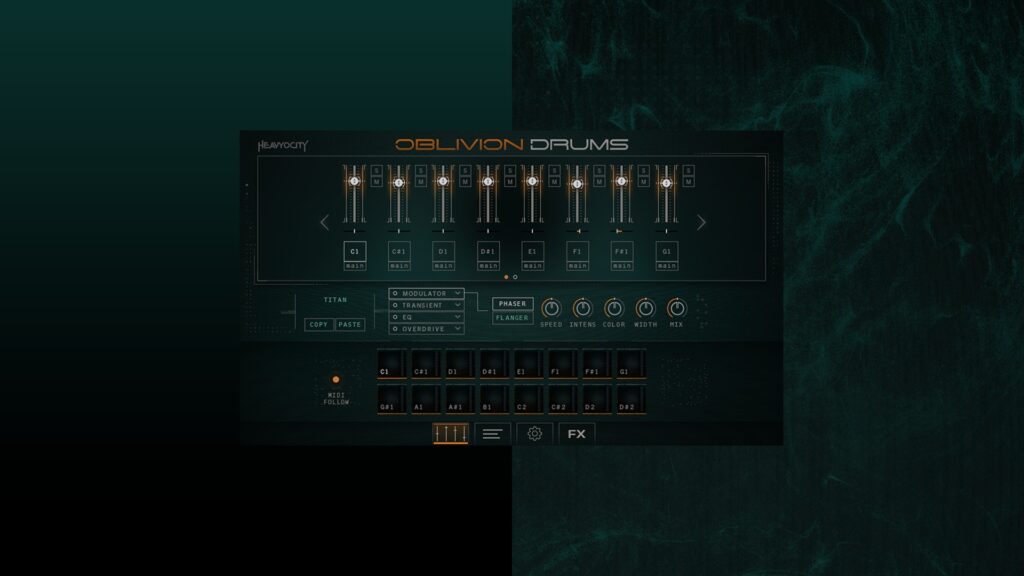
Going into Oblivion Drums, my biggest fear had nothing to do with whether it would sound aggressive enough. This is Heavyocity we’re talking about — the company whose identity is built on cinematic percussion that hits like a freight train. My fear was the opposite: that everything would be too squashed, too saturated, too choked. That the drums would be all impact and no breathing room. Especially given the Doom Eternal pedigree of sound designer David Levy, I was bracing for relentless sonic compression that would fatigue the ear after thirty seconds.
My fear was proven wrong. And the way it was wrong is what makes this library genuinely worth talking about.
What This Is (and Isn’t)
Oblivion Drums is the percussive companion to Heavyocity’s Oblivion — their “aggression designer” instrument. Where that library dealt in aggressive melody, harmony, and bass, this one brings the same design philosophy into the world of drums, hits, and rhythmic content. It ships with over 30,000 samples across 99 presets and more than 500 loops, organized into three instruments: Loop Designer, Ensemble Designer, and Kit Designer. It runs on the Kontakt 7 engine (Player compatible, so no full version required), weighs in at roughly 12.6 GB, and retails at $149 with intro pricing at $129 — or $109 if you already own Oblivion.
If you’re familiar with Heavyocity’s ecosystem, you’ll be at home immediately. The interface follows the same architecture as their other titles, which is a genuine advantage. There’s no learning curve to navigate — just load it and start working.
But let’s be clear about what this is not: this is not a general-purpose drum library for every genre under the sun. This is purpose-built for aggressive, in-your-face, industrial-leaning percussion. It does that spectacularly well, and as I discovered, with considerably more nuance than the marketing language might suggest. But if you’re looking for brushed jazz kits or delicate acoustic snares, you’re in the wrong aisle.
The Sound: Power Without the Chokehold
“This has the aggression, the assertiveness, the punch, but it doesn’t get choked up.”
This is where Oblivion Drums genuinely surprised me. The sounds are big and aggressive, yes — but they have a quality I’d describe as a grainy, slightly pillowy edge. The bigger kicks and snares don’t clamp down on your mix. They don’t create that fatiguing, over-compressed density that plagues a lot of hard-hitting sample libraries. Instead, there’s a roundedness to the edge of the sound — a sense that someone thought carefully about how these drums would feel in context, not just how they’d sound in isolation.
“These hit hard, but they don’t get fatiguing. That’s really difficult to do.”
That distinction matters enormously for working composers. A sound that impresses on first hit but becomes tiring by the second bar is functionally useless in a real project. Oblivion Drums avoids that trap with remarkable consistency across its content. There are some individual snares and kicks that push into genuinely extreme territory, and honestly, there should be — edge cases serve a purpose. But the core palette is balanced in a way that lets you build full arrangements without everything fighting for the same frequency space.
Loops That Actually Complement Each Other
“Rather than taking space from each other, they kind of open them up and enhance each other.”
The Loop Designer is probably where most composers will spend their initial exploration time, and for good reason — it gives you the most immediate, high-production impression of what this library can do. Loops are organized into All Stars collections (curated best-of selections) along with Breakout categories and Utility folders that separate content by frequency range — highs, mids, and lows.
What struck me most wasn’t just the quality of individual loops, but how intelligently they’re paired. I’d isolate a high-frequency element and think it sounded surprisingly edgy and aggressive on its own. Then I’d layer it back in with the rest of the loop and it would settle into something more subdued, more complementary. That’s not accidental — it speaks to Heavyocity’s ability to arrange and mix elements that enhance each other rather than competing. From a mixing standpoint, the elements clearly scoop space for one another, which means your percussion section doesn’t collapse into a wall of dense noise the moment you start layering.
“I would play a full loop and I’m like, that’s a very nice cool pattern. Then I listen to an individual element and it sounds actually a lot edgier than I thought. And then I play it with the rest of the layers again and it complements the big picture in a very interesting way, becoming way softer.”
The system also lets you break loops down into their component layers and recombine them freely. This is essential. Being locked into a complete loop with no way to pull out just the hi-hat pattern or just the low-end pulse would be, frankly, hard to tolerate in a modern production tool. Here, you can grab exactly the rhythmic element you need and pair it with your own orchestral percussion, your own kicks, whatever serves the track. The stutter effect mapped to the lower keys is also a familiar but very welcome inclusion — digital destruction at the press of a key, which is a lot of fun when you want to add some chaos to a transition.
Beyond the Big Hits
“If you’re going for like an industrial, techy, technological, slightly futuristic-leaning type of sounds, then this does that excellently.”
One thing worth emphasizing is that Oblivion Drums is not just a library of massive hits. Some of its most useful content lives in the high-mid and high-frequency rhythmic material — the kind of intricate, processed loops that add motion and texture to an action cue without dominating the low end. If you have a film or game cue where the orchestral and low-frequency elements are already established and you just need something percussive to inject forward momentum, these utility loops solve that problem immediately.
The Experimental folders are also worth digging into. They skew weirder, which means they won’t be for everyone, but for composers who appreciate patterns and textures beyond the more typical — these can be exactly the right kind of strange.
Ensemble Designer and Kits
The Ensemble Designer sits in an interesting middle ground — part kit, part loop, part performance tool. You get single-hit notes alongside rolls and rhythmic patterns, which makes it a kind of hybrid tool. The Cinematic Mod Wheel Jam preset is a standout here, offering dynamic control that works beautifully for tension-building scenes where you need percussive energy that ramps and recedes with the drama. The Ambient Realms presets also deserve mention — bigger, more voluminous impact sounds with an atmospheric quality that makes them useful for transitions, scene changes, and dark ambient music, all categories that are surprisingly underserved in most percussion libraries.
“The sounds are immediately inspiring because when the sound has such a specific profile and shape, it kind of alludes to a certain rhythm and a certain flow.”
The Kit Designer is where things get the most immediately playable. The kits are clearly defined, immediately readable — I could play a few notes and instantly understand the layout and start building grooves. They’re big, they’re punchy, and crucially, they maintain that same non-fatiguing quality I found throughout the library. The sound pairings within each kit are strong enough that they inspire rhythmic ideas almost involuntarily. A kick suggests a tempo, a snare implies a backbeat, and suddenly you’re playing rather than auditioning.
“These are really, really well tracked, produced, recorded and mixed.”
Who Is This For?
If you’re composing for trailers, action games, sci-fi, industrial music, or any context where you need percussion that sounds like it was forged in extreme signal processing and pushed to its limits, Oblivion Drums is a strong choice. If you already own the original Oblivion, the pairing is natural and arguably the best companion you could ask for — the two libraries share a sonic DNA that makes them immediately compatible.
But I’d also argue this is worth a look for composers who might not think of themselves as “aggressive percussion” users. The high-frequency rhythmic content, the textural loops, the ambient impacts — these are tools that serve subtlety as much as they serve brute force. The library’s real achievement isn’t that it hits hard. Plenty of libraries hit hard. It’s that it hits hard while having its own unique tone and texture. It remains musical, mixable, and — perhaps most importantly — pleasant to listen to despite its aggressiveness nature.
Get it here: https://heavyocity.com/products/oblivion-drums
Prefer Video?
Full Deep Dive: https://youtu.be/Gj8AqFHNerU
‘No talking’ Demo: https://youtu.be/8NzaR9d9DWg