There’s something admirable about a sample library that refuses to stay in its lane, even when it defies its own subtitle. Orange Tree Samples’ Latitude — subtitled Latin Rock Percussion — arrives with a name that suggests one thing and delivers something considerably broader. At its core, yes, this is a deeply sampled collection of Afro-Cuban, Brazilian, Caribbean, and Latin percussion. But spend any real time with it and you’ll realize the subtitle undersells what’s actually here. This is a comprehensive percussion toolkit that happens to be anchored in Latin and world percussion traditions — and that distinction matters.
What This Is (And What It Isn’t)
If you know Orange Tree Samples, you probably know them for guitars. Their Evolution series has set a kind of quiet benchmark for acoustic and electric guitar realism in the sample library world — playability that actually translates from fingers to something that sounds like a real instrument being played by a real person. Latitude represents their most ambitious foray into percussion, and it arrives with the same philosophy: meticulous sampling, musical playability, and a sound that breathes.
This isn’t a loop library. It’s not a construction kit. And it’s not a narrow genre exercise. Latitude houses 376 individually sampled instruments across 88,000 samples, recorded at 48kHz/24-bit and compressed into a surprisingly manageable 15 GB install using lossless NCW encoding. You get up to 16 round robins and up to five dynamic layers depending on the instrument — numbers that matter less as specs and more as experience. When you play a conga or a cajón here, the repetition simply isn’t there. Every hit feels like a distinct moment.
“The sampling here is just stellar, stunning. The sound is very natural — polished raw is how I would put it.”
The Sound: Polished Raw
That phrase — polished raw — keeps coming back because it’s the most honest way to describe what Orange Tree has achieved here. These instruments sound like themselves. There’s no excessive processing burying the character of the wood, skin, or metal. But there’s a sheen to everything, a professional maturity to the recordings that makes them sit beautifully in a mix without requiring much intervention.
The low end, in particular, deserves special attention. Kick drums and kick-adjacent elements across Latitude share a quality that’s genuinely difficult to engineer: they’re big, warm, deep, puffy, and present — centered around 50Hz — but they don’t bleed into territory they don’t own. They don’t fight your snares or muddy your toms. For composers working in orchestral or cinematic contexts, that kind of controlled low end is gold. These kicks can sit alongside orchestral percussion without sounding like a drum kit was shoved on top of an arrangement.
“The kick is a beautiful, soft, establishing, puffy breathing thing — just down there below where it needs to be and nowhere else.”
And the air. There’s a genuine sense of air moving in these recordings, a quality of openness and breath that separates carefully captured percussion from the clinical, vacuum-sealed samples that populate so many libraries. You feel the room. You feel the instrument resonating in space.
“I can hear air move. It’s such an important thing for me when it comes to great sounds.”
Grooves, Ensembles, and Kits: Three Ways In
Latitude is organized into four main categories — Grooves, Ensembles, Kits, and Menus — each offering a different entry point depending on what you need.
The Grooves are pattern-based, not audio loops, which is a critical distinction. The engine triggers individual instruments through MIDI patterns, meaning everything locks to your DAW tempo and you retain full flexibility to swap instruments, change patterns, or adjust dynamics. The pattern library exceeds 1,500 entries spanning Afro-Cuban, Brazilian, Caribbean, Latin, and songwriter styles. What impressed me most wasn’t the breadth of styles but the musicality — these groove genuinely. There’s push and pull, subtle timing variations, longer cycle lengths that introduce natural variety. They don’t feel programmed in the sterile, quantized sense.
“These groove super nicely. If you want to go super traditional, it’s gonna be there. But there’s a lot of weirder, more groovier stuff as well.”
The Ensembles are curated instrument groupings designed to be played hands-on. This is where Latitude reveals some of its most unexpected character. Alongside the expected congas-and-timbales combinations, you’ll find presets like “Mystery Box” and “New Age Rainforest” — ethereal, textural combinations built from ocean drums, thunder tubes, wind wands, and log slit drums. One ensemble pulled me into what I can only describe as a shamanic ritual in some strange, beautiful swamp. For composers who work in darker atmospheric or cinematic territory, these edge-case sounds alone justify serious attention.
“I loved the weird, ethereal, holographic things that took me into that kind of swamp shaman ritual place.”
The Kits were the genuine surprise. I didn’t walk in expecting fully fledged drum kit sounds from a library called Latin Rock Percussion, but what’s here is remarkably good. The snares are snappy and detailed, the cymbals — particularly a stunning Istanbul 22-inch ride and a Sabian 18-inch hi-hat — are beautifully captured with complete articulation maps. Each kit has its own character without repetition across the roughly 30 available setups. If you work in pop, jazz, soul, folk, or anything wanting an organic, airy acoustic kit sound, these could honestly justify the purchase price on their own, with the entire world percussion collection as an extraordinary bonus.
“It’s revealing itself to be a fully fledged drum kit sound lineup as well. If you like this enough, it could be the only reason you get this.”
Engine and Interface
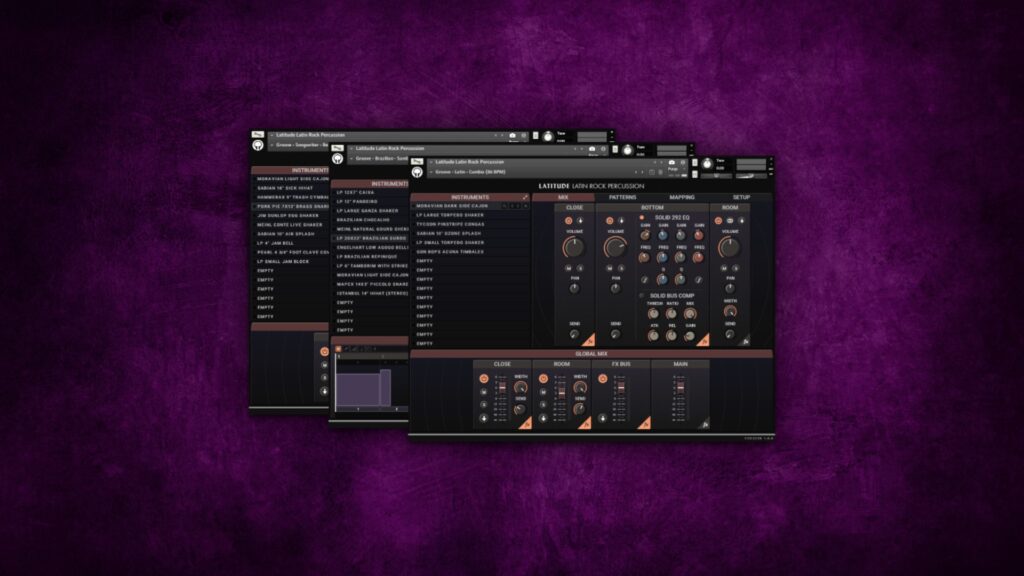
Latitude runs in NI’s free Kontakt Player (version 7.6.0 or newer), so full Kontakt isn’t required. The engine is thoughtfully designed — instrument icons with photographs make browsing intuitive rather than text-heavy, and a favorites system lets you curate your go-to selections. The mix window provides close mic, room mic, effects bus, and main output controls per instrument, and the predictive pre-roll system anticipates leading notes up to 100ms, eliminating the need for negative track delay — a practical touch that matters in production.
There are a couple of interface quirks worth noting. The instrument browser scrolling feels a touch slow and gel-like, and the icon grid could benefit from a density option to reduce scrolling. In the groove presets, only the first instrument in a group is directly playable from a single MIDI channel, which makes sense technically (each instrument seems to need its own channel for independent pattern triggering) but isn’t immediately intuitive if you want to quickly audition an individual sound within a groove. The greyed-out mic option in the mixer also visually reads as “unavailable” rather than simply “off,” which could confuse new users. None of these are dealbreakers — they’re surface-level polish items on an otherwise well-built engine.
Who Is This For?
The honest answer is: more people than the name suggests. If you compose in any genre that uses acoustic percussion — and that’s nearly all of them — Latitude has something for you. The library excels at its core Latin and world percussion mandate, delivering Afro-Cuban, Brazilian, and Caribbean styles with authentic grooves and comprehensive instrument coverage. But it reaches well beyond that into songwriting, pop, folk, rock, jazz, orchestral, cinematic scoring, and ambient sound design.
For orchestral and cinematic composers specifically, the combination of controlled low end, airy presence, and musical dynamics makes these instruments blend effortlessly with orchestral elements. The kicks punch through without dominating. The snares cut without harshness. The cymbals breathe without washing out.
“If I want to pair snares or kicks with orchestral elements, these are sitting in a very nice place — they have punch, they cut through, but they are open and airy and big.”
Final Perspective
At $199 full price ($159 during the introductory period through May 31, 2026), Latitude offers a staggering amount of content. I struggle to think of another single library that covers this breadth of percussion — from congas and timbales to ocean drums and thunder tubes to complete drum kits — at this level of sampling quality. Orange Tree Samples clearly invested a lot of time in this, and the depth shows. The instruments sound like instruments, not samples. The grooves feel like performances, not programming. And the scope reaches far beyond what the subtitle promises.
If the naming gives you pause — if you’re thinking I don’t do Latin rock — look past it. What’s actually inside is one of the most versatile and beautifully captured percussion collections I’ve encountered. For anyone who needs acoustic percussion in their work, Latitude deserves a very serious look.
Get it here: https://www.orangetreesamples.com/products/latitude-latin-rock-percussion
Prefer Video?
Full Deep Dive Review: https://youtu.be/2fZVmPpHUzw
‘No talking’ Demo: https://youtu.be/_bBtd9QsNJs