For a while now, the Circles drum samples have lived a strange double life. Among many producers they were something close to a secret — the drums you reached for when you wanted a kit that felt deliberate rather than merely great-sounding. And yet actually using them meant paying a small, recurring tax. You loaded them into your sampler of choice, opened a library, hunted for the right snare, and more often than not ran a second or third instance just to marry a kick from one kit to a snare from another. We did it anyway, the way musicians always do, because the sounds were worth the trouble. Sound is what survives the session; everything else is logistics. But there was always a quiet friction between owning these samples and playing them, and anyone who’s managed a meticulous folder system knows exactly the friction I mean.
Circles — the instrument, now arriving under the Circles Audio name rather than the old Circles Drum Samples banner — is the company’s answer to that friction. It’s a modern drum instrument built to house the entire Circles ecosystem in one place: browse, shape, and play multi-sample drums without ever leaving the window. And before I go any further, a bit of housekeeping, because it matters to how you should read all of this. I know Stefan, the man behind Circles. I came to him the ordinary way — I bought the samples, liked them, eventually had him on my podcast, and we became friends. I’m also compensated for the time it takes to produce a piece like this. None of that buys a verdict. I haven’t been asked to say anything in either direction, and the fact that the samples were already a known quantity to me is precisely why I went in with my guard up rather than down. When you already love the raw material, the only interesting question is whether the people handling it can build something worthy of it.
I should also note that I reviewed Circles in a pre-release state, so some details may have shifted since, and any small kinks I ran into might already be smoothed out — though in truth I had few gripes to begin with. Check the website for the final feature set before you draw your own conclusions.
So that’s the real frame here. This isn’t a review of whether the Circles sounds are good — that ship sailed years ago, and producers quietly proved it by hauling these samples through clunky workflows long before there was an elegant way to do it. The question is whether Circles the instrument earns the sounds it’s been given. And I’ll say up front what this piece is not: it isn’t an exhaustive crawl through every sample in the box. There’s far too much here for that, and frankly that’s the wrong way to understand an instrument like this. What I wanted to know was how it feels to live inside the thing.
What surprised me is that Circles didn’t simply import the old samples and call it a day. The sounds have been worked on inside the new engine — fine-tuned with transient shaping, drive, tone, tuning, and more. And none of this is glued across the master output the way effects usually are; it lives on every channel individually, which is to say on every drum.
What the “dead” sound is really about
To understand why Circles exists at all, you have to understand the dead samples, because that aesthetic sits at the core of much of what the company has done. Anyone who’s recorded drums in a band context eventually has the realization — you deaden a kit right down, and instead of sounding small it sounds controlled, intimate, full of texture you’d normally drown in reverb. It’s a niche taste. Most libraries still default to big rooms and bigger reverbs, chasing a generic kind of largeness and missing the magic that actually lives in drums: the minutiae, the small textural details, the specificity. I don’t want a big generic sound. I want to hear and feel the whole sound. That philosophy — restraint as a feature, not a limitation — is what made Circles a cult tool, and it’s the thing no competitor has really gone as hard into.
What the instrument adds is access. The room mics from every original session are now on tap, so you can dial the blend of dead and room per kit piece rather than living with whatever was baked in. Those samples were always sitting in storage; now they’re alive and adjustable.
DAW-Level Polish, Beautifully Tuned Controls
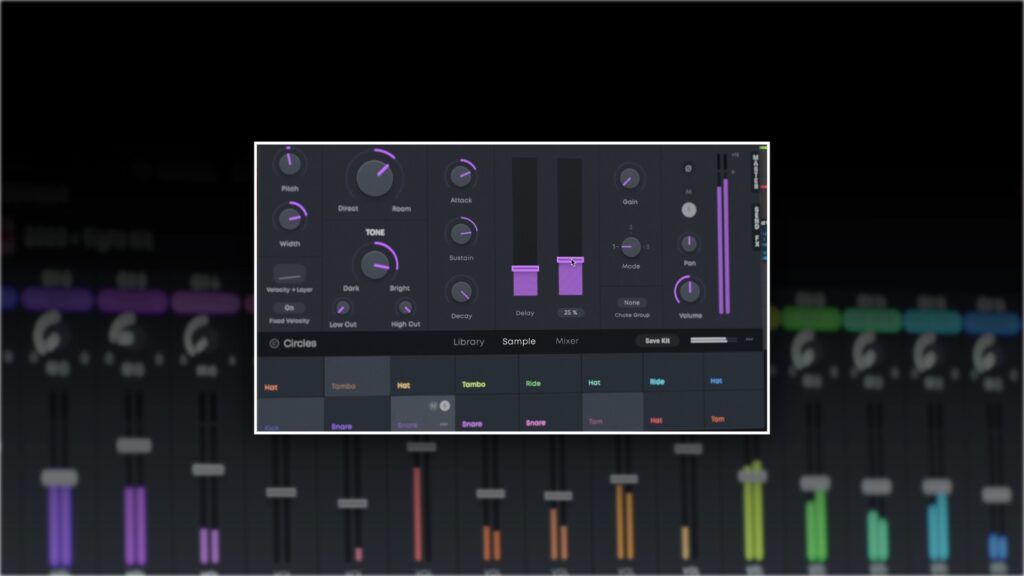
The first thing that struck me — and it kept striking me — is how clean the whole environment is. The interface splits into a sample page for per-piece tweaking, a library page for browsing presets, individual samples, and beats, and a mixer. That mixer is the tell. So many drum libraries try to look like hardware, cramming a console into too little space until you’re squinting at tiny knobs in a cluttered panel. Circles went the other way entirely. This literally feels like I’m using a DAW, in the best possible sense. Not once did I hunt for where something lived. For an instrument carrying this much content, that ease is not a small achievement — it’s the whole game.
The per-sample controls are where you’d expect a company to drop the ball, but the restraint and maturity here is genuinely tasteful. Width, for instance: in most instruments, cranking the stereo field gets brain-bending and weird fast. Here, even at full crank it stays natural — no part of the spectrum goes excessive. The tone control isn’t the brittle high-shelf push that used to pass for “tone” across the industry; it stays musically relevant wherever you push it. The transient shaper, with its sustain and decay, can take an already-tight kick somewhere even deader, or coax a resonant tail out of it. And the drive offers soft clip, tape, and harmonic flavours, which quietly opens a door I didn’t expect — you can take an acoustic sample and nudge it toward something electronic. Across all of it, even at the literal extremes, nothing felt overblown. You might make the wrong choice for a given track, but you won’t make an ugly one.
A couple of workflow touches deserve real praise rather than a polite nod. The built-in beats drag into your DAW as MIDI, not audio — which means you’re never stuck chopping a loop; you can rework the part however you like. That single decision makes the whole library dramatically more flexible. And the way the samples re-curate the originals is the kind of thing only someone who cares would bother with. These aren’t the old packs dumped wholesale into a new shell. Circles clearly imported each one, remapped it, and went through asking how to improve it — a touch of pitch shift here, a little transient shaping there. It gives the sounds a dimension and flexibility the sample packs could never have.
Living With the Sounds
Once you start playing, the thing that defines Circles becomes obvious: there’s no guesswork. With a lot of libraries the drums sound good, but you never quite land on that immediate, star-struck falling in love moment. Here you hit a snare and instantly know — yes, keep that one around. The dead lineup did exactly what I hoped; Volume One remains some of my favorite drum samples, period, and the kicks have no business being as fat as they are. But the surprises were the real joy. Dead Hi-Fi, which I’d never touched before this, turned into one of my favourites in the whole box — open and airy on the surface, with grit and character sitting underneath. The Digi inclusion is quietly the smartest move in the package: plenty of companies have attempted 808s and 909s, but making them feel warm and full and impactful instead of brittle is rare, and these sit beautifully.
Even the heavily stylized kits resist becoming costumes. The 1990 and 2000 libraries have the oomph and soul to escape their eras; the Dead Digital kit nails an unmistakable 80s vibe without tipping into cheese, partly because it stays a dead library rather than burying everything in period reverb. And the character packs — Dust, recorded to tape through sixties mics, or Indie, captured raw and a little sloppy in a garage with ribbon mics — are exactly the kind of thing that makes you think differently mid-session. What ties it together is the breadth of high-hat tones, which sounds like a small thing but isn’t. Having that much texture to work with is what gives hi-hats true depth, and is the signature of someone who actually understands drums.
I’ll register the few reservations, because they’re real even if they’re minor. My one genuine wish is a favouriting system — a way to star a sample the instant it grabs you and drop it into a favourites folder, so that building your personal Circles universe doesn’t depend on memory. You can already save custom kits, so the destination exists; it’s the getting there that could be smoother. I’d also love a dedicated doubling slot on the keyboard for fast playing, even when you can freely assign drums to any key you want. It would just be a slight added workflow thing that makes playing faster and easier. Also a quick on/off to A/B an effect like the shaper, and a drag-to-pad cue that appears on hover rather than after a click. None of it undermines the instrument. These are the notes you leave for something you want to keep using.
The Deciding Factor
At $129 for the core set and $349 for the complete package — with a rent-to-own option that sensibly widens the door — this strikes me as genuinely competitive, not only for the appealing quantity but for the scope and the character of what you’re getting. If you make music with any seriousness and love the Circles aesthetic, it’s an easy proposition.
But the price isn’t really the decision, and neither is the workflow, because the workflow is no longer in question — nothing about the usability or flexibility here is going to be the thing that stops you. The decision comes down to the sound, the way it always should. Circles has its own voice, and there isn’t much out there doing anything close to it, especially in that controlled, textural, dead-leaning territory. If that voice speaks to you, this belongs in the conversation for the one drum instrument you’d reach for to cover most of what you do. It did, in the end, turn out to be everything I hoped it would be — which, given how well I knew the samples going in, is about the highest thing I can say.
Get it here – https://www.circlesaudio.com/
Prefer Video?
🕵🏻♂️ Full Deep Dive: https://youtu.be/8tZlvyajMnU
🤫 ‘No Talking’ Demo: https://youtu.be/tZGkX2i-fD8