Greg Schlaepfer and I sat down to talk about sample libraries and spent the first half hour on children, home surveillance, bicycle theft and Californian drivers. By the time we reached virtual instruments, we had already established most of what the episode would turn out to be about: attention, patience, the ethics of how you make a thing, and the strange fact that the most impressive work is almost always the work that refuses to draw attention to itself.
The archive and the moment
We started, as parents do, with time. Greg has a fourteen-year-old and a ten-year-old; I have a nearly-four-year-old and a nearly-two-year-old. The observation we both arrived at independently is that adult time accelerates while a child’s time does not.
“For kids it doesn’t. To get through school and make it to the weekend, it’s like forever. So I have to remember when I was that age and remember that feeling of time moving so slowly.” — Greg
I record my kids constantly. Terabytes of it. I have started to run into an actual storage problem, which is a very modern kind of sentence to say out loud. My reasoning has always been that they will one day have something I do not have: a record of who they were before they had any say in it. I would like to know what kind of baby I was, because I suspect it would tell me something about the difference between my nature and the things that happened to it later.
But there is a cost hiding in that, and Greg named it plainly:
“There are moments where I’m like, okay, this is just something I need to be present for. Put the phone away. No recording.” — Greg
This is the tension I have not resolved. The archive is built out of moments of divided attention. If I film everything, my children’s memory of me is a man behind a screen, laughing at a small rectangle instead of at them. The recording preserves the event and quietly degrades the experience of it. There is no clean answer here, only a running negotiation, and I think being honest that it is a negotiation is better than pretending either extreme is virtuous.
The same logic showed up when we talked about the idea of a passive camera in the home that uses AI to catch the good moments for you. Conceptually beautiful. Practically, a surveillance device in your living room. Greg’s caveat was that if it ran locally, on his own hardware, he would feel differently — and that led us somewhere I did not expect to go on a music podcast.
“Nothing is secure. It’s just about levels of deterrence.” — Markus
I was talking about locks and bikes. But I have thought about that line a dozen times since in completely different contexts. Almost nothing in life is solved. Things are made sufficiently expensive, sufficiently inconvenient, sufficiently unattractive. Your health, your attention, your creative time — you do not protect any of it with a single perfect defence. You protect it with layers, none of which would hold on its own, all of which together make the alternative easier.
Why oranges
I had assumed the company name was a whim. It is better than that.
There is a stage illusion from the 1800s called the orange tree: an elaborate mechanical device that grows a tree in front of an audience and sprouts real oranges from it. Greg was deep into magic when he needed a name in 2008.
“That kind of aligned with my interests in developing these libraries that have all this intricate scripting behind them — kind of the mechanism inside of that orange tree device.” — Greg
This is the most useful metaphor for the whole craft that I have heard. A sample library is a machine that must never be perceived as a machine. All the scripting, the round robins, the release samples, the fret logic — every hour of it exists to be invisible. If you notice the mechanism, it has failed.
Magic and instrument design turn out to share more than that. Greg pointed out that YouTube has made almost every classical trick public knowledge, which means magicians can no longer coast on secrecy; they have to be more inventive than the generation before them.
“It’s forced magicians to be more and more creative. And I feel like it’s the same way with virtual instruments — we have round robins and release samples and legato samples, but there’s still a lot more that we haven’t discovered, and the bar keeps getting pushed higher.” — Greg
Transparency raises the floor and forces everyone upward. This is worth remembering when the availability of tools and knowledge feels like it is devaluing skill. It is not devaluing skill. It is relocating it.
Translating fewer dimensions into more
Here is the central technical problem of Greg’s working life, stated more elegantly than I could have:
“It feels like you’re translating from fewer dimensions into more dimensions. You can’t just play a key on the keyboard and also tell it what fret and string to use. There has to be some interpretation.” — Greg
A keyboard gives you pitch, velocity, and a couple of continuous controllers. A guitar gives you six strings, twenty-odd frets, two hands doing categorically different things, and a hundred incidental noises that carry meaning. The instrument builder’s job is to invent the missing dimensions — to guess, convincingly, at everything the player did not have the means to say.
Which is a fair description of most communication, and most art. You have a low-bandwidth channel and a high-bandwidth intention. Everything interesting happens in the interpretation layer.
What I love about Orange Tree’s guitars is that the interpretation layer is not just accurate, it is suggestive. Greg described the effect he chases:
“It makes you play differently because you’re hearing the sound of a guitar come out of the keyboard.” — Greg
I know this feeling intimately. I am not a guitarist. But if I know how a guitar behaves and I load a preset where the articulations have already been decided by someone who does, I put my hands down and something happens that would never have happened with a piano sound under my fingers. The instrument is not a passive container for my ideas. It has opinions, and its opinions change mine.
Greg used the word partner for this, talking about a library he admires:
“It almost partners with you. It inspires the music instead of you just handing it the sheet music and saying, play this, make it sound as realistic as you can.” — Greg
That is the distinction I would draw between a tool and an instrument. A tool executes. An instrument argues back.
The maturity of hearing what is actually there
We spent a while on realism.
My relationship with samples has never been primarily about whether they sound “real”. If I load a violin patch and it sounds like a slightly broken harmonica, I do not experience that as a failure. I hear a slightly broken harmonica, and I ask what a slightly broken harmonica is good for. Some of my favourite sounds are cheap old Casio samples that are wonky and lo-fi and completely themselves.
Greg’s response was disarmingly honest: he was on the other side of that for years.
“I was so focused on realism and getting more and more realistic sounds that I didn’t appreciate what those early, lo-fi sounds provided on their own.” — Greg
Which makes complete sense once you consider the vantage point. If your entire craft is the pursuit of believability, and the technology is fighting you, a sound that fails to be a violin is a defeat. It took distance — and nostalgia — for those same sounds to become interesting again.
There is a general principle in here about labels. A sound arrives pre-named, and the name tells you what to compare it against, and the comparison is nearly always a story about what it lacks. Strip the label and you get a plain description of what is in front of you. This is close to what the best producers seem to do instinctively — use a piece of gear for what it actually sounds like, rather than for what is printed on the button.
A business built on something other than money
Greg started Orange Tree Samples in August 2008, alone, recording his own bass, shipping instruments he had built in a couple of weeks, and marketing them by posting anonymous audio clips on forums and DMing anyone who replied. Seventeen years later, the structural decision he is most attached to is one an investor would consider a mistake.
Everyone who plays on an Orange Tree library — musicians, engineers — receives royalties on every copy sold. Not a session fee. An ongoing share.
“I would hate for him to be in a situation where he essentially has to compete against himself, because somebody makes a decision whether they hire him or just buy a sample library.” — Greg
Sit with that for a second. A session musician who records a sampled instrument is, in a sense, manufacturing in part his own replacement. Greg’s response is not to pretend this isn’t happening; it is to make sure the musician is on the right side of the transaction either way. He is candid that this makes the company less “investable”. He does not appear to care.
“I would much rather be in the trenches, actually working directly on the sample libraries, than hiring people to do all the work for me and being the CEO.” — Greg
This is where I want to push back on a lazy piece of received wisdom. There is a widespread belief right now that the problem is capitalism. I do not think that is quite it.
“There’s nothing built into capitalism that says you need to maximise for profits and nothing else. That’s a decision a bunch of people make in a company.” — Markus
Incentives lean in a direction, certainly. But a business owner has enormous latitude in what they choose to maximise: the quality of the thing, the fulfilment of the people who make it, how they feel when they close the laptop. Greg has chosen a set of variables and accepted a lower number on one of them. The result, by his own account, is a queue of collaborators eager to work with him and roughly thirty instruments already recorded and waiting. Optimising for people is not charity. It compounds.
The same question is arriving now with AI-generated instruments, and Greg’s instinct went straight to it: whoever recorded the audio that trained the model should be part of whatever that model earns. Whether that is achievable is a hard, unsettled question. That it is the right instinct seems clear to me.
Eleven years, three interfaces, and the cost of doing it properly
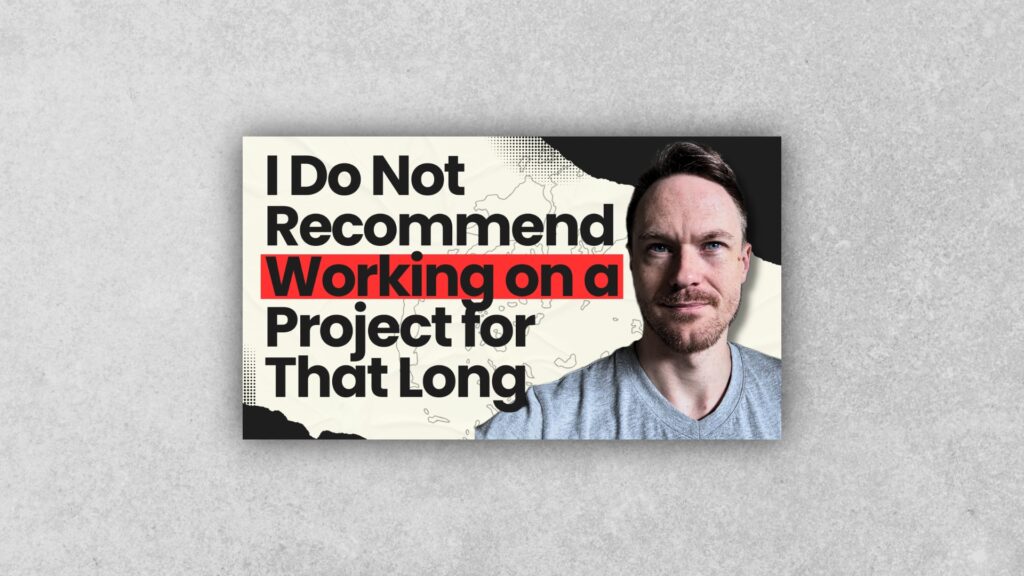
Orange Tree’s Latitude percussion library took about eleven years.
“I do not recommend working on a project for that long.” — Greg
Three hundred and seventy-six instruments, with another forty or fifty already sampled and unreleased. Phases of burnout. The interface scrapped and redesigned from zero three separate times, with a binder of sketches that never got used.
What strikes me is the failure mode he was steering around: not ugliness, but density.
“Trying to organise the interface in a way that had all the features we wanted, but wasn’t like looking at an airplane cockpit.” — Greg
Every long project accumulates. Features arrive one at a time, each individually justified, and the sum becomes hostile. Subtraction requires you to throw away work you have already paid for, which is why so few people do it, which is why so much software feels like a cockpit. Three full restarts is not indecision. It is a refusal to ship the accumulation.
The same restraint shows up in how the thing was recorded. The engineer, Mike Arvold, gave Greg a line I have not stopped thinking about:
“His goal is to impart the feeling of distance to the sound without it sounding roomy.” — Greg
Distance without room. You can always add a hall with a reverb; what you cannot fake is the sense of standing a certain number of metres from a real object. That is an extraordinarily precise thing to be aiming at, and it can only come from years of a person physically moving a microphone and moving their own head, listening for where the space and the instrument agree with each other.
Every note has to earn its place
Towards the end, I asked what advice Greg wishes he had received when he wanted to write for film and games. His answer had nothing to do with music.
“Learning that the relationships with people on the team is very important, maybe even more important than your musical abilities.” — Greg
And then, the second half:
“Show restraint. Sometimes it’s more effective to not score a scene. You don’t have to show everybody the extent of your musical knowledge at every second.” — Greg
This is the thread that ties the whole four hours together. He put the theory of it better than I have heard it put:
“Impressing people is the most basic way of emotionally moving somebody.” — Greg
Not the wrong way. The basic way. It works once. The second impressive fill is less impressive than the first, and by the fourth you have taught the listener to stop caring. Whereas B.B. King, in Greg’s example, gets more out of one note than most players get out of forty — and that is what stays with you years later.
I have spent a lot of my life on the other side of this. In bands as a teenager I was reliably the worst musician in the room, and I distinctly remember the pattern: someone writes a great simple riff, we play it enough times that it stops feeling novel, and then you want to complicate it. Not because the song needs it. Because we have become bored, and because complexity is what insecurity reaches for when it is not sure the simple thing is enough.
“You need to have the ability to see the song and nothing else. You need to forget your capabilities and your skill and be in the service of it. That’s ultimately a very anti-ego, anti-intellectual process — trying to get out of the way and do as little as possible.” — Markus
Greg’s answer to the boredom problem is the best practical version of this I have heard. Boredom is a real signal and it is worth taking seriously, but the response does not have to be more. It can be finer:
“Even if you’re playing just a plain backbeat and you start feeling yourself getting bored — okay, where are you placing your snare hits? Are they slightly behind the beat, slightly ahead? What serves the music best? And suddenly you’re not bored anymore.” — Greg
“Doing simple things with detail and nuance is really, really difficult.” — Greg
The zoom level changed, not the content. That is a transferable skill, and I suspect it is most of what separates people who get very good at something from people who get restless and move on.
What is an artist?
I ask everyone this. Greg’s answer came in two halves, and the second half is the interesting one.
The first half is generous and broad: he recognises the artistic mindset in people from any field — including, in his example, a dentist who lights up talking about a filling. The marker is not the medium. It is the flow state, the losing of time, the right side of the brain taking the wheel.
Then:
“Being a good artist also means you have to be able to create art without inspiration. If I’m feeling uninspired, I definitely feel in those moments like I’m not an artist. But a good artist is able to work through that and write a good song anyway.” — Greg
This is the line between a hobbyist and a professional, and I do not think it is a line between purity and compromise. What makes someone a professional in any craft is how repeatable the process and the results are, and how fast. Creativity is finicky and we all feel different every single day for reasons we mostly do not understand. If you only work under favourable internal conditions, you will work about a dozen days a year.
We ended up back where we started, on the clock. Greg made a case for working late, when the analytical part of you is tired enough to stop interfering. I think there is something else in it too:
“There’s something about recognising that this time is unusual and undefined. You look outside and there’s nothing anywhere and everything is dark. It’s unknown territory. It frees you from expectations and assumptions about what can live in this space.” — Markus
Daytime comes with a script. Night does not, and that emptiness is permission.
One thing on every lock screen
My last recurring question is this: if you could put one message on the lock screen of every smartphone on the planet, so that everybody had to read it before unlocking, what would it be?
Greg’s first instinct was read the manual, which he immediately withdrew on the grounds that he never reads the manual either. What he landed on instead:
“Be curious about things and ask questions. That mindset can be applied in so many different ways in your life — in your art and creativity, in your life, in spirituality.” — Greg
It sounds soft until you notice how much it costs. Questions lead to more questions and to problems you did not previously have. Most people decline for exactly that reason. Greg has spent seventeen years asking what is inside a note that nobody has sampled yet — the buzz of a finger leaving a string, the sound before the transient, whether a legato transition is really one event or several. That is what curiosity looks like when it is left running for a couple of decades.
It builds an orange tree with a mechanism inside that nobody in the audience ever sees.
Greg Schlaepfer is the founder of Orange Tree Samples.
https://www.orangetreesamples.com/
Prefer Audio or Video?
🔴 Youtube: https://youtu.be/vbJ-DZtxTuA
🟢 Spotify: https://open.spotify.com/episode/0Bu5gWWMC6AdAOEVKS5iD5?si=ypFjmFu6Q7-TCriWK_yRPw
🟣 Apple Podcasts: https://podcasts.apple.com/ca/podcast/how-do-you-make-a-keyboard-believe-its-a-guitar/id1528017679?i=1000782657942