Early in the Silentium manual, before a single system requirement, Stefano Maccarelli explains why he samples at all. For many, he writes, sampling is a way to capture acoustic instruments and reproduce them as faithfully as possible. For him it’s something different: “a way of capturing the essence of instruments, voices, objects, and environments,” then turning them into the building blocks of a sonic world.
I know some people roll their eyes at this sort of thing. I don’t. Every instrument grows out of the philosophy of whoever built it, and the deeper the flavor of a library, the more that philosophy matters. If it doesn’t click with you, that’s usually an instant pass, no need to dig any further. If it does, there’s a good chance the library will too.
It clicked. Then I spent the better part of five and a half hours playing through Elements Silentium on camera, which is either a glowing endorsement or a cry for help. Possibly both.
A world, not a collection
Silentium is the newest entry in Zero-G’s Elements line, subtitled a “dark folk virtual instrument,” and the first thing worth clarifying is what that actually means. This is not a deep-sampled orchestral library, and it isn’t a single instrument either. It’s closer to a toolkit bound together by one aesthetic: intimate strings (double bass, cello, violin), a whole family of plucked folk instruments from tagelharpa and lyre to saz, oud, zither and, to my quiet Finnish delight, kantele, plus classical guitar, a felt piano, a dedicated “horror piano,” ritual voices, winds, earthy percussion and a surprising seam of synths.
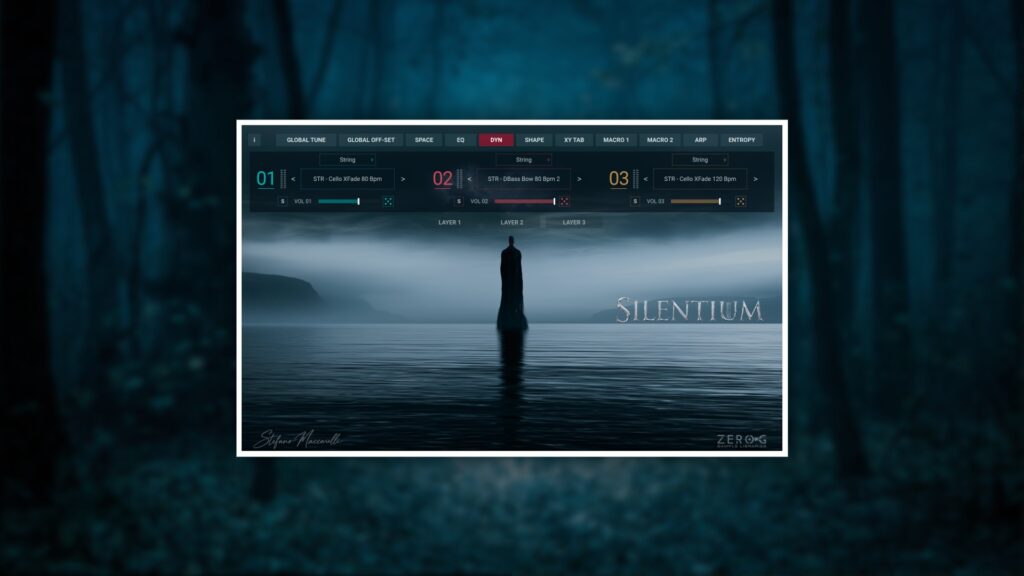
All of it lives inside three systems. The Designer is a three-layer engine where each layer gets its own source, key range, envelopes, filters and effects. The Builder is a phrase-sequencing instrument for male choir, solo female and solo male voices. And Vocal Phrases is a playable phrase instrument with waveform navigation and an XY effects page. Underneath sits around 25 GB of 24-bit, 48 kHz samples and more than 600 presets, which is exactly why this is a reflection rather than an inventory. Looking back at the library size after the review, it’s astounding that a library that sounds this vast takes up so little space.
Practicalities, quickly: you need the full version of Kontakt 8.12.1 or newer, so the free Player won’t cut it. Zero-G recommends a fast drive, a 512-sample buffer and plenty of RAM, 64 GB or more for large sessions. I ran it from an external USB 3 SSD with 64 GB without drama. Load times aren’t instant or on the faster side, but a batch resave should help.
As always, a word on how I approached this. It was a blind first impression. I hadn’t heard a demo or watched the trailer, and everything I played came straight out of the box with no added EQ, reverb or compression. Zero-G sent me a copy and compensated me for the time it took to produce the video and this article. As always, I don’t accept being told what to say or not, so all opinions are my own.
Cinematic snapshots
The Instant Cue folder pulls from across the whole library, so that’s where I started, with a preset called The Hollow Crown. It took about three notes.
I go immediately into writing music, which is exactly what it should do.
What struck me across this folder was the production. The balances are so considered that each preset arrives as a finished soundscape, the stage already set, oozing emotion without hogging mixing space. Several left exactly the right gap for a solo cello or a voice to sit on top, which tells you someone was thinking like a composer, not just a sound designer.
Now, an honest confession. I’m not a big layered-zone person. I’m far too obsessive about part-writing to let one patch voice my strings and guitar for me, so I’d mostly split things out and play them separately. But I came to see the Instant Cues as story perspectives: little masterclasses in sound pairing that show you which sources belong together, which you can then take apart and use your own way. The arpeggiator helps enormously. It doesn’t sound arpy in the slightest and behaves more like a mature, human pattern sequencer.
Even calling it an arp is kind of lowballing it.
There are some absolute bangers of folk presets in this folder, too. Even my own sloppy rendition of a medieval kingdom going to war couldn’t ruin them. Well, at least not completely. And if you name a preset The Shire or Techno Viking, I’m contractually obliged to play it. So if you’re after brilliantly crafted folk presets, especially with a medieval lean, this library deserves a good chunk of your time.
Strings with dust on them
The strings were the first real revelation. I’ve watched Stefano’s string work grow across his recent libraries, always built with a clear understanding of what the samples could and couldn’t do, but here they’re properly playable, with each articulation getting its own approach rather than one patch trying to do everything. More importantly, they sound heartachingly dark, with a beautiful amount of rawness and impurity, body noise and all.
These just live and move with real heart. This sounds like it’s an actual take, an actual piece of music.
The double bass deserves its own mention. A natural but bolstered low end is genuinely hard to find in strings; it tends to come out either too round and boomy or not weighty enough. Here it clunks into place, dominant and thick without spilling everywhere. One textural preset, sitting high in the bass’s range under a heavy reverb, pushed and pulled like a wave and already sounded screen-ready. These patches reward keeping active with the mod wheel, and the quietest dynamics fade to complete silence, which, given the name, feels about right.
Then there are the plucked folk strings, which are so far down my alley I could hear the alley echoing. Tagelharpa, lyre, cetra and friends all share that dusty, wooden, perfectly slightly-out-of-tune character, full of resonances and tiny tuning shifts, with release samples that make every strum feel intentionally ended.
I feel like I can feel every brush and pluck of the strings.
Not everything is flawless. Some (and I emphasise only some) of the lyre sounds and configurations tighten up in the top register into something more old-school sampler-sounding, and the kantele, lovely as it is to have, comes across slightly constrained and direct, missing some of the radiant ringing that happens once you’re in the actual presence of the instrument, and its strings start resonating with each other and the body.
Big boy drums
In a lot of libraries like this, percussion is an afterthought: good enough, but you reach for something else. Not here. The Viking toms, tribal drums, and the barbarian drums are big, hefty and polished while keeping their organic rawness, with loose, wet drum heads that give a lovely transient bite. Pile notes close together and the resonances start talking to each other the way real drums in a room would. They also stayed remarkably playable at a 512 buffer, where I’d normally want 128 or less. The drums are so good that I’d happily pay the full price of the library for them even if nothing else came in the box.
These are actually so good that I need to make some notes for myself to bring these drums to the front on some of the stuff that I’m working on next.
Even the Bells and Shaker preset won me over, and I’m not typically a pro-bell person. It captures the essence of all that ringing without any of the harshness.
The voices
Given Stefano’s track record with the Ethera Gold series, still among the best solo voice libraries I know, I suspected the vocals were always going to be the main event. And they are. Somewhere in the Dark Sirens and Pagan presets I stopped reviewing and started writing, and I came very close to crying on camera. Later on, I actually did. Stefano has somehow done it again. There’s a raw, unguarded melancholy and beauty here that goes straight past the ears and into the chest.
This is what music is about. This is why I love music. This is why I write music.
The phrase tools are where it gets clever. In Vocal Phrases, changing notes mid-phrase follows the pitch remarkably smoothly, though you’ll want to pick phrases whose shape suits your melody, just as you would with real singers. Just be a composer, basically. The ‘pirate’ chants surprised me most: an older, rooted male choir that sounds like the local men’s group that meets every other week and is sound slightly weathered in a perfect way. That’s a genuinely underserved color, and I loved it.
Keys, textures and a cassette recorder in the woods
The felt piano is stunning: present, emotional, with a solid low end, and good enough to be sold as a library of its own. The more angelic piano presets pull off something I’m usually allergic to, that heavenly openness without tipping into cheese. And the Textures folder holds one of my favorite moments of the whole session.
That has to be one of my favorite ethereal piano tones, sounds, presets that I’ve ever heard.
When it comes to the synth content here, there’s a dystopian, faintly cyberpunk streak running through the library, at one point like Daft Punk’s Tron meeting Blade Runner, and it fits the colorscape better than you’d expect. The winds, meanwhile, are hyper-stylized and raw, as if someone set a cassette recorder down in a village square, and they all but beg for a small indie game about building that village.
A few practical gripes. Some presets can be very loud and a few are very velocity-sensitive, so watch your levels. The Kontakt 8 preset previews are maximalist and long. They sound beautiful and show you a lot of what each preset can do, but they can also make some presets seem far busier than they turn out to be once you actually play them, as well as eating up a bit of your production time. Some wind patterns can get repetitive enough to turn comic unless you pick them carefully and understand what you’re writing. And in the designer view main panel, I’d love a mute button there on each of the three layers, not just solo and level.
Final thoughts
Summarizing a library of this scope is close to impossible, so here’s where I landed. Silentium is a deeply programmable instrument, but its real gift isn’t the engine. It’s Stefano’s ear for pairing sounds, and the way almost every corner of it suggests a piece you haven’t written yet.
A key term I would use for this library is inspiration.
It’s for composers working in dark, folk, medieval, Nordic and cinematic territory, for anyone scoring games with a handmade feel, and for dark ambient people who want a treasure trove of organic textures. If you’re after a clinical, one-to-one orchestral library, look elsewhere. That was never the point.
At a full price of $149.95, with an introductory discount at launch and an extra 20% off for existing loyalty Elements and Ethera owners, the value is honestly a little absurd. Almost any single instrument category in this library would justify the price on its own if you love the sound, and certainly if you need it for a paid project. And if you like one thing in Silentium, you’re probably going to like something else too, if not most of it.
I usually say the highest praise I can give is forgetting the camera is rolling and just writing music. Silentium got that, plus tears. I’m not sure there’s a higher grade, which is just as well, because I don’t give them.
Get it here:
https://zero-g.co.uk/products/elements-silentium
Prefer Video?
🕵🏻♂️ Deep Dive Review: https://youtu.be/qb2Hg5LQhMw
🤫 ‘No talking’ Demo: https://youtu.be/bMi9sBDzFHM