I sat down with composer Seth Tsui for about three and a half hours. He was in Bangkok, about to move to Taiwan. I was in Finland with a hospital bracelet still on my wrist from that morning. Neither of us planned for the conversation to be about the cost of doing this work, but that’s where it kept landing.
Seth is best known to players for his music at Riot Games, on League of Legends and Teamfight Tactics, and to composers for sample libraries like Jade Ethnic Orchestra, Jade Evolutions and Arabian Ethnic Orchestra. He’s now building a new company, Nomad Sounds, with its own sampler. What follows isn’t a recap. It’s the ideas I haven’t been able to put down since.
Three forks, three refusals
Seth’s career reads as a series of moments where an institution offered him advancement, and the advancement pointed away from writing music.
The first was orchestral trombone. He went to school for performance, looked at what his peers were grinding toward, and saw the whole path end to end.
“The best possible outcome is this: after many years, you can retire having made all this great music. But you’re making other people’s music.”
Not even your own interpretation of other people’s music, as he pointed out. The conductor’s. The ceiling of the path is a form of excellence with your fingerprints deliberately sanded off.
The second fork was Hans Zimmer’s Remote Control Productions, where he landed in 2013 as a Logic technician. There were two visible tracks there, mixer or additional music composer, and a third thing everybody actually wanted that had no stepping stones at all. To get your own name on a film you either got invited by a director or anointed by a composer with too much work.
“You’re trying to suck up to the composers just so that this magic wand might land on your shoulder at some point. And sometimes it never happens.”
Normally the wait is about ten years. The question isn’t whether the wand is real, it’s whether you want to spend a decade in that room holding a lottery ticket, in a culture where not sleeping was a point of pride. His roommate, who worked there too, gave him the advice that stuck:
“Quit before you become an asshole.”
The third fork is the spine of the episode. He arrived at Riot assuming he’d been hired as a creative, at what he thought was the most musically adventurous game company in the world.
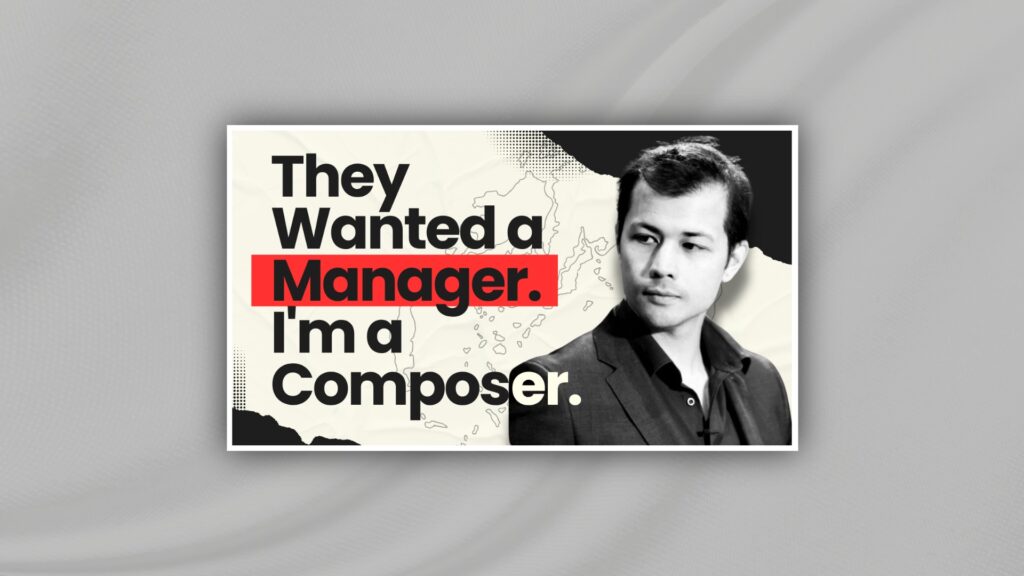
“When I got there, I found that everybody was obsessed with becoming managers. Nobody was talking about the actual craft of what they were doing.”
His title was manager of composers, and he technically didn’t have to write a note, so he spent his days in meetings and then wrote music until two in the morning, every day. In Singapore the air conditioning shuts off at 7:30pm, so he asked for a button. Three months later somebody calculated that each press cost the company about $120.
“I would have gotten paid exactly the same amount if I had clocked out at 7:30 and gone home like everybody else. But I wouldn’t have felt as fulfilled if I stayed.”
He left knowing he will probably never earn that much again, because the role they’d mapped out was a full managerial track with zero creative authorship.
“That was not one that I wanted to look back on and say, where did the last 10 years go?”
None of this is specific to Seth. All three forks presented themselves as progress, and you can always argue you’re moving closer to the thing you want. You can be right about that while doing less of it every year. I said as much on the recording: I’m currently writing almost no music, which is the thing I most want to be doing. Recognising the pattern doesn’t exempt you from it.
Leadership is the willingness to not count
My position has been that leadership is fundamentally sacrifice. The invisible work, last to eat, not a job title but a way of doing things.
Seth learned it touring, and had the better story. When it was his music he was the leader, which meant writing the checks, booking the rooms, making sure everyone ate and that a car existed to get the band to the next venue. One day he’d driven four hours and rehearsed for eight when the trumpet player asked for a break. Seth pointed out he’d been going just as long.
“And he’s like, ‘You don’t count. You’re the leader.’ And that stuck with me forever, because it’s totally true. It’s my vision. I need to sacrifice for it.”
You don’t count. Brutal, correct, and the cleanest version of the idea either of us managed on the day. It’s also why I’ve come to think caring about something is worth nothing on its own. If I love my family and never demonstrate it, they have no way of knowing it exists, and if I sacrifice nothing for it, neither do I. The demonstration is the thing.
Ownership, piracy, and who actually pays
Seth won’t sell his libraries by subscription, and the reasoning isn’t commercial.
“I don’t replace sounds as fast as I replace computers. The sounds become part of who you are. The computers become as flexible as water.”
He still has sounds in his template from the start of his career because he’s never found a better cymbal roll. A rented instrument can’t be part of your signature, because a signature has to persist.
I’d assumed sane pricing had mostly solved piracy. It hasn’t. A library he releases tomorrow is on the pirate sites tomorrow. And his objection isn’t the obvious one, because he explicitly doesn’t care about the fifteen-year-old pirating everything from a bedroom. That was him, and that kid isn’t a customer.
“I would go to these million-dollar studios that had a giant SSL board and 90 channels of Neve preamps, and they had pirated Jade Ethnic Orchestra on their hard drives just for the principle of it.”
The arithmetic took me a second to see. When the people who can easily pay don’t, prices rise so the remaining honest buyers can fund the next project, which prices out exactly the people who couldn’t pay in the first place. Piracy by the well-resourced is a tax on the under-resourced.
The tools are not the music
When a friend visits the studio and I press one key and something enormous comes out of the speakers, the reaction is usually that I’m not really making music, the computer did it. My answer is that you could hand any two of us the same libraries, the same brief and the same month, and get completely different records back.
“These tools, they can be amazing, yes. But they are not music yet. And they don’t write music for you.”
Seth’s answer was better than mine:
“If I got behind the wheel of the best engineered F1 race car in the world, I crash and burn. It’s exactly engineered to do the thing that it’s doing, and I have no idea how to drive it.”
He also took it somewhere I hadn’t. The outputs differ not just by skill level, but because a composer is a specific and unrepeatable accumulation of accidents.
“I have no idea how all these experiences in my life came together to write the music that comes out of me every single day. I’m making music that nobody else could have made.”
His is trombone, jazz, Tchaikovsky and every Nintendo 64 score he absorbed as a kid. Mine is stranger. At six my parents put me in the local boys’ choir and I stayed nine years, starting as a soprano and singing the same mostly-Bach repertoire again as an alto, a tenor and eventually a bass. I sang the same counterpoint from inside every voice in the texture for nearly a decade before I knew the word counterpoint. It was not a happy nine years, and it’s the largest compositional gift I’ve ever been given.
Nobody worries about being replaced by a piano.
The thing he’s actually afraid of losing
I told Seth about a recent fear. For thirty years I assumed my drive to write music was inexhaustible, and lately I’ve wondered whether age is changing the equation. Not my access to the creative fountain, which feels intact, but the energy needed to sit down and get there at all.
His answer split the question in a way I hadn’t. He’s worked inside the studios of composers who stay prolific into old age, and the appetite doesn’t go. They build teams around them because the projects they now get carry delivery expectations one person cannot physically meet. The big studio is a delivery mechanism, not a retirement plan. What he’s afraid of losing is narrower:
“What I’m worried about is the willingness to jump on a very high-risk project.”
He can feel himself getting more efficient and less wild. His answer to that, while still at Riot, was to decide the company needed a Tony award and write a musical about Jhin, a serial killer with OCD fixated on the number four. It’s built on perfect fourths in 4/4, every outside influence enters in three or five and clashes, and the music resolves only when he kills that person. Then, rather than sit on the idea, he used the company’s five-day creative free-for-all to get ten people to illustrate it as a motion comic, and talked the actual League voice actor into recording it.
“Even if it falls flat, I would rather try eight of these and have none of them succeed rather than stay in my job, make a bunch of music that’s pretty good, make a bunch of money, and 10 years later look back and go: I didn’t do any of those cool things that were in my head.”
There’s a working method attached that I’ve already stolen. He doesn’t walk away from a cue when he gets stuck. He writes a measure or two and deliberately leaves, often until the next day, at which point he knows exactly what to do with it. The trigger for leaving isn’t being blocked:
“I don’t normally get stuck. What I’ll normally do is start to fall into patterns. And that’s what I don’t want to do, because when I start to fall into patterns, I’m creating perfectly serviceable music that nobody will ever remember.”
Then he reorganised the whole idea for me by pointing out that getting stuck is itself a defence against falling into patterns. If you weren’t stuck you’d produce the competent version and never need a process at all. The block is the part of you that knows the easy version isn’t worth making.
What he’d tell a young composer
I asked, as I always do, for a definition of an artist.
“Something that creates something that wasn’t there before.”
His parting words were for young composers watching the low and mid-paying gigs that used to be how you learned get hollowed out by AI. His answer wasn’t reassurance. The despair is about losing the old path, and the old path was never the point. If you’re growing up native in these tools, that fluency is a lever nobody a generation older has. The job description hasn’t changed: make something that never existed before.
Every refusal in Seth’s career was a refusal of a path where the thing he made would have been interchangeable with something someone else made. The ownership philosophy, the piracy stance, the musical about a serial killer counting in fours, all the same instinct pointed at different targets.
The ladder is always there, and it always points somewhere. It’s just very rarely pointing at the work.
Seth Tsui’s new company is Nomad Sounds. His libraries with Strezov Sampling include Jade Ethnic Orchestra, Jade Evolutions and Arabian Ethnic Orchestra. Full episode links, socials and music are below.
Prefer Video or Audio?
🔴 Youtube: https://youtu.be/1sh0YE08lTc
🟢 Spotify: https://open.spotify.com/episode/35rCseagpbL0JTtOxj4BSR?si=fOJtBjjNRgeFEWkevdYM1g
🟣 Apple Podcasts: https://podcasts.apple.com/ca/podcast/why-he-walked-away-from-writing-music-for-hundreds/id1528017679?i=1000789754399
🔗 Seth Tsui Links
🌐 Website: https://www.sethtsui.com/
🌐 Nomad Sounds: https://nomadsounds.com/
🔴 Youtube: https://www.youtube.com/@sethtsui