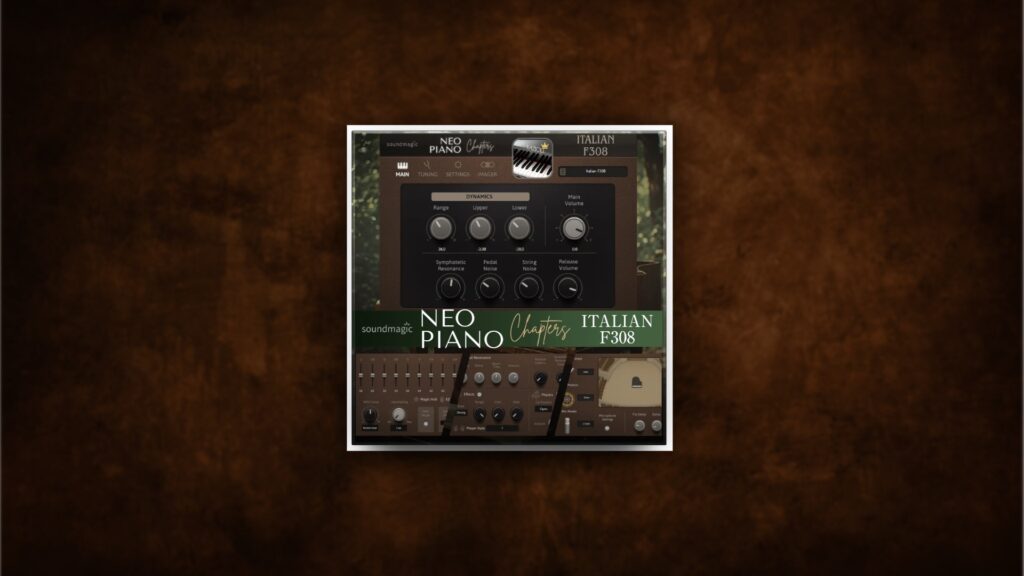
Most piano libraries arrive making an argument about size. More microphones, more velocity layers, more gigabytes, more of everything, as though realism were a storage problem waiting for a bigger drive. Neo Piano Chapters: F308 makes the opposite argument, and it makes it quietly: 550 megabytes for a full concert grand, with a set of controls that would look at home on something twenty times its size. The interesting question isn’t whether that’s technically impressive. It’s what survives the translation — and whether what’s left over is actually musical to play.
Having now spent a long session with it, I think the answer is mostly yes, with a few caveats that matter more to some people than others.
What this is, and what it isn’t
Sound Magic describe F308 as inspired by the legendary Fazioli F308, which is careful wording and worth reading carefully — this doesn’t appear to be an officially licensed collaboration, so treat the name as a stated point of reference rather than a badge. What’s under the hood is what they call hybrid modeling: as far as I can tell from the outside, a real instrument is sampled extensively, that material is studied, and the engine then generates rather than plays back. They’re claiming 127 true sampled velocity layers, the maximum dynamic resolution MIDI 1.0 allows, with more than 512 effective dynamic layers available if you’re driving it from a MIDI 2.0 controller. I can’t verify how any of that is done. But conceptually it’s the part that drew me in, because capturing 127 layers is one problem and editing them so the dynamic curve actually develops musically under your fingers is a much harder one. You can’t simply decide that layer three is layer three; if it doesn’t behave like layer three when you play it, you’re re-recording or reshaping until it does.
What this isn’t: a preset library. There’s essentially one instrument here and a deep set of controls for shaping it, which means you don’t audition F308 by clicking through a list — you audition it by playing and tweaking. It also isn’t a tonal chameleon. The core sound is a big, clean, crisp, detailed grand, and nothing in here pulls it far from that identity. And despite ambient being named on the product page, it isn’t an ambient machine on its own. Pair it with reverb and further processing and it slots beautifully into spacious, cinematic writing. Ask it to generate that atmosphere by itself and you’ll be reaching for other tools.
Price, at time of writing, sat at $99 against a $169 list, with no stated end date on the discount. More on that later, because it’s the part that requires actual thought.
First contact
I played this blind — no rehearsal, no preset hunting, just opening it and listening. The first impression is clarity. It’s meaty and crisp without being aggressive, coherent and sharp in a way that reads as a well-recorded big instrument rather than a bright one. The top end was the surprise: I expected the usual grand-with-clarity brightness, and got something that thins out beautifully into delicacy when you play softly up there.
I expected a big grand with clarity, and it does have that typical good kind of crispiness to it. But once you pull to the top end, you can really make it lovely and light and quiet, very delicate and sensitive. I do very, very much like that.
Out of the box the dynamics are, to my ear, essentially perfectly judged. I never wanted to touch the range controls. There’s a moment in the middle register where a velocity step felt slightly larger than I’d like, and in certain ranges I felt some notes damped faster than I’d expect, but these are observations rather than complaints.
In terms of the dynamics, out of the box I think it’s pretty much perfectly tuned. I actually like the behaviour of this out of the box. I think it’s perfectly balanced on that front.
The mids are noticeably scooped in the default state — big lows, airy highs, hollowed-out centre — and the default stereo image has a kind of swooping quality, lows anchored left, highs drifting right and further back. That turned out to be a setting rather than a characteristic, which is the first clue about how this instrument wants to be approached.
The controls that do real work
Buried under a tab labelled Effects — which is a misnomer, since there are no effects in there — sits the most interesting thing in this instrument. Six player styles, driven by what the manual calls a loudness algorithm, that change how the piano behaves from the ground up. Style two is the roundest and warmest, style four the crispest, style six the most tactile and transient-forward, and the differences are not subtle. I’m playing identically and getting genuinely different instruments back. This is the single strongest tonal lever in F308, and my only real request is to be allowed to push it further than maximum.
A control that basically strongly changes how the instrument behaves from the ground up is very interesting. I love this concept a lot. This should be in more instruments for sure.
The physics page is the other place where things move decisively. Lid open versus closed is a big, obvious, useful difference — I lean closed. Hammer hardness is audible and useful from about halfway to maximum; below halfway it starts behaving more like a filter scoop than a change of hammer material, and I stopped believing the metaphor. Sympathetic resonance is the control I enjoyed most on this page. Pulled down, you get a drier, more classic, more clinical piano. Pushed up, it stops being more reverb-like and becomes something closer to an organic pad layer sitting inside the instrument, harmonically richer than many reverbs would give you. That’s where I started wanting a button marked “beyond maximum.”
The imager is where you should start
By the time I’d worked through the mic section I’d changed my mind about workflow. The imager affects the sound so much that tweaking piano tone before setting it up is working backwards. Mic technique, pattern and model each contribute, and they contribute musically. The mic models give you meaningfully different perspectives — more beefiness here, more crispiness there, more openness or roundness — without ever making the instrument sound like something else. The patterns are subtler: omni is the fullest and roundest, cardioid brings in that crisper pop and is probably the sensible starting point.
All of these sound musical. They sound meaningfully different. There’s no “oh, that’s just a filter,” or “that’s just a bit of EQ.” They don’t sound gimmicky. They don’t sound glued on. They give you musical, significant enough sound changes, but none of them change what this sounds like. It still sounds like itself.
Mic technique is the one place I’d push back on the defaults. F308 opens on NOS, which carries that scooped, backward-leaning image I noticed in the first few minutes, and AB is, to my taste, too phasey — arguably accurate modelling of AB pairs, but not something I’d choose for solo piano. XY and MS both sit properly in phase, and XY in particular gives you a balanced, even field to build on. If it opened there, first impressions would be better.
The space section was the genuine surprise. It behaves less like a reverb and more like a room, and you can drag the piano around inside it, which affects tone as much as position — some locations reinforce the low end, others thin it. The height control extends the sense of size rather than changing character. Studio, small room and hall all share a family resemblance, differing in reflections and scale more than personality.
I frankly didn’t have any expectations going into the space modelling side, but I really, really dig that tone — it feels less reverby and more like actual space.
There’s no EQ anywhere in here, and I’m of two minds. I’d rather have no EQ than a bad one bolted on, and plenty of instruments have taught me that lesson. But a tastefully voiced EQ placed before the imager would add real flexibility, because right now any EQ you reach for lands on the finished sound rather than inside the chain.
The page I nearly skipped
The tuning page looked like a niche inclusion for people playing repertoire that calls for historical temperaments — worthwhile, but not for me. Then I started detuning individual notes by a few cents, more or less at random, and the instrument became noticeably more organic. Not out of tune; just not machine-perfect, which is what a real piano is. It sits better. I’d love a randomise function with a user-set range and a one-click reset, because doing it by hand is slow for something this useful.
The slight shifting in the tuning brings more organicness to it. It seems to sit in a more natural place. I would actually love to see this in more pianos.
Rough edges
I got occasional random note dropouts throughout the session. I raised polyphony to maximum, changed buffer size, and neither helped — VST3 in Cubase on macOS, so it may well be specific to my system or to this version, and it’s something I’ll be following up with Sound Magic. I also couldn’t hear the pedal noise or string noise controls doing anything at all, at any setting, with or without playing, which is strange given that sympathetic resonance works exactly as advertised. That smells like a bug rather than a design decision, but I couldn’t confirm it from my end.
More broadly, a fair number of controls live in a grey zone where I genuinely couldn’t tell whether something changed. That’s clearly deliberate — this is built as an instrument of nuance, not of dramatic gestures — but I like my tools to give me audible, tastefully voiced differences, and the band of near-inaudibility here is wider than I’d draw it.
Who this is for
If you reach for a grand to sit inside an orchestra — big, symphonic, classically leaning, or cinematic writing that needs a piano with presence and clarity — this fits that job well. If you’re a gigging pianist who doesn’t want to haul a sample library around, the 550 megabyte footprint and low CPU load make a very direct case: fire it up and go, with no meaningful latency penalty at a modest buffer.
One of the best selling points this has is definitely the footprint, the size. You can just fire this up and go.
Which brings us to price. Sound Magic’s stated mission is affordable professional tools, and by my reckoning $99 doesn’t quite land in that category — not expensive, but not trivial either, and well above the sub-$50 space where the answer is simply “why not.” At a hundred dollars, the question becomes specific: does this offer something you particularly want? For a lot of people the honest answer will be the footprint, and that’s a legitimate reason. For others it’ll be the player styles or the tuning page, both of which I haven’t really seen done this way elsewhere.
What stays with me isn’t the velocity-layer count that drew me in, or the storage figure that frames the marketing. It’s that two of the features I’d single out — a control that rewrites how the instrument behaves, and a detuning page that makes it breathe — are the kind of ideas that should propagate. F308 is a focused, purist instrument with a couple of genuinely unusual ideas hiding in it, and if the bugs I ran into are real, they’re fixable. I’d rather review something with that shape than another flawless piano with nothing to say.
This review was produced in paid collaboration with Sound Magic. The fee covered the production time for the video, the no-talking edit and this written piece. The conclusions, in both directions, are entirely my own, and were not submitted for approval.
Prefer Video?
🕵🏻♂️ Full Deep Dive Review: https://youtu.be/GW5o-Ch8T6c
🤫 ‘No talking’ Demo: https://youtu.be/D9fhe2aaLLY