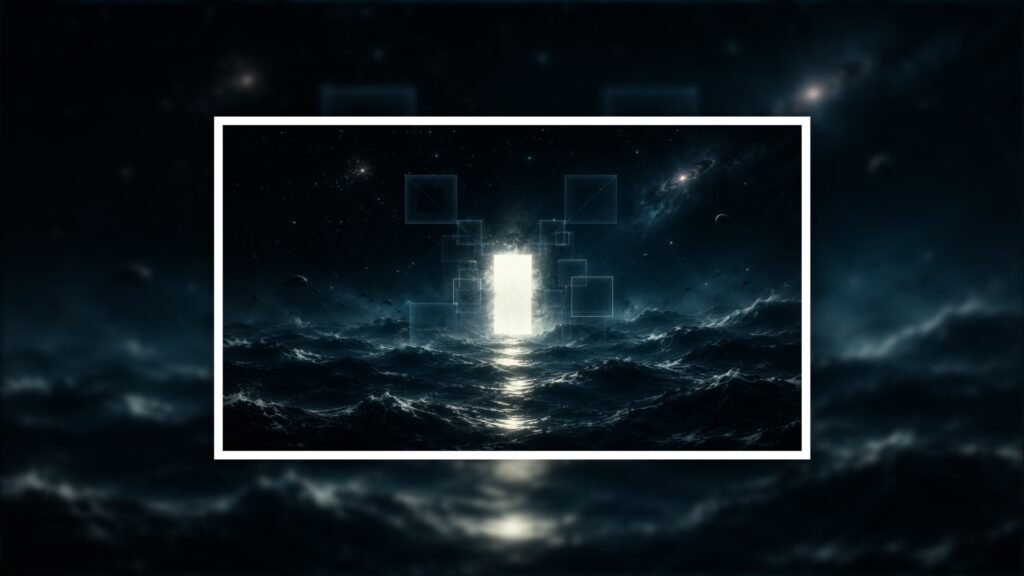
You hear a knock. You shuffle over to answer it, only to find your front door has been replaced by four shimmering portals, each one calling your name like a siren with a modular synth habit. Has it always been like this? Have you been asleep your whole life? Are you, possibly, tripping? Hard to say. Either way, somebody knocked, and it would be rude not to answer.
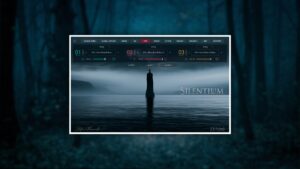
That, more or less, is what loading Door Tetra into Kontakt feels like. It’s the latest from Silence + Other Sounds (or Silence and Other Sounds — I still don’t know which, and at this point I’m too afraid to ask), and it arrived with a manual that reads like the lore section of a sci-fi novel and, when I first sat down with it, no website and no audio demos. Just two documents, a Kontakt instrument and a few hours of exploring with completely fresh ears.
By the end of those hours I’d stopped noticing the interface altogether and was simply shaping sound. That, more than any feature, is the story of this review.
Psychological sci-fi, not another synth pulse
The developer’s own framing tells you a lot. The manual points out that in most trailer and cinematic music, sci-fi tends to fall straight into the expected clichés. Door Tetra instead calls itself psychological science fiction, with a generous dose of the avant-garde and a darker, more lysergic strain of psychedelia than the happy sixties variety. Don’t worry, I had to Google “lysergic” too. In this context, it essentially means psychedelic or hallucinogenic, after lysergic acid, better known as the “L” in LSD. I’ve also never seen a sample library describe itself as psychological before, and I love it.
Even the name pulls double duty. Tetra is ancient Greek for four, which maps neatly onto the four-cornered design at the heart of the library, while tetro in Italian means dark and gloomy. Both describe what you’re getting.
So it’s worth being clear about what this isn’t. It isn’t a ready-made trailer kit that serves you finished cues on a platter, and it isn’t a collection of clean, conventional synth pads. It’s a composing toolkit with a concept behind it and a set of instruments built to apply that concept, after which it’s up to you to make music. I tend to gravitate towards libraries built this way. One practical note before going further: Door Tetra requires the full version of Kontakt (6.8 or later), so the free Kontakt Player won’t open it.
From mountains to the Continuum
The way these sounds were made goes a long way towards explaining why they feel the way they do. The raw material came from voices, speech, found sounds, acoustic instruments and field recordings captured in industrial facilities, warehouses, mountains and even archaeological sites (entirely legally, I’m sure). I can’t help picturing a Fellowship-style moment on a mountainside:
“We must get off this mountain!”
“Not until I’ve recorded this piece of snow and rock!”
Those recordings were then rebuilt through additive resynthesis in Symbolic Sound’s Kyma, about as deep as sound-design geekery goes, and turned into playable patches. Crucially, the patches were then performed by hand on a Haken Continuum Fingerboard and recorded live, exactly as you’d record an acoustic instrument. The microtonal drift and timbral wobble you hear weren’t programmed; they’re the residue of a human hand. That’s why so much of Door Tetra sounds organic and otherworldly at once, which is a balance a lot of sci-fi libraries miss in one direction or the other. Everything is delivered at 96 kHz/24-bit, around 5.9 GB in total.
Spatial Morph: four rooms and an orbit
Door Tetra is split into two instruments, and Spatial Morph is where most of my time went. Four sound spaces sit in the corners of an XY pad, drawn from 138 sources across ten categories with names like Explorations, Meditations, Transmissions, Landings, Revelations, Reactions, Hallucinations and Communications. Read them out loud and they sound like the worst rap song ever written. However, luckily, there is no rap to be found here. They’re perspectives rather than descriptions, though — they tell you how the developer hears the material more than what it literally is — so expect to learn the palette by ear rather than by label.
I always say that four-corner XY libraries live or die on their source material. Weak sources turn the concept into something tedious, even unusable; strong ones make a simple idea far more powerful than it has any right to be. Door Tetra lands squarely in the second category. Every corner is distinct enough that you can read a preset within seconds — keep this, lose that, lean into here — yet cohesive enough that the blends between them stay musical.
“Very simple concepts, but they amount to such meaningful musical tools for your sound shaping.”
The orbit paths are what bring it all to life. Rather than parking the cursor, you can send it travelling along geometric routes (circles, squares, squiggles and a gallery of far stranger shapes) at tempo-synced rates. I fully expected the fast rates to turn gimmicky, bubbly in the bad way, choppy and harsh. Instead they hold together beautifully. A circular orbit gives you a smooth, burbling motion; a squiggle at speed starts sounding like a granular engine scanning a sample unpredictably. And because many of the samples evolve internally too, the variation compounds into something you couldn’t predict if you tried.
“It’s remarkable how buttery the edges are. This pulsates in a very pleasant way. It doesn’t get harsh or choppy at all.”
My favourite detail is that you can still drag the cursor while an orbit is running, shifting the overall emphasis without stopping the motion. Tiny movements make massive differences. Add per-layer levels, filters and LFOs (each corner shows little bubbles rising in time with its LFO, a genuinely clever bit of visual feedback), plus dice buttons that randomise any single layer, and you have a proper sonic sandbox. Love a preset but not its bass layer? Roll the dice until the right partner turns up.
Darkness with a pulse
The snapshots are organised into Spaces (Drones, Explorations and Degradations) and Structures (Pulsations and Subtle Rhythmic). As a lifelong dark ambient fan, I went straight for the drones, dropped my session tempo from 100 to 80 BPM to slow the orbits down, and immediately knew where this was going.
“I’m already hearing it. It’s going to be a dark ambient master machine for me.”
Degradations was another highlight: distortion, noise, bit-crushing and broken signals that drift towards a gritty, lo-fi, almost dungeon-synth darkness, all crispy and crunchy in exactly the right way. But Structures is where Door Tetra genuinely surprised me. The engine generates rhythm from sources that aren’t percussive at all, purely through sequencing and orbits, and the results are dark, dystopian and remarkably solid as cinematic under-beds. The low end in particular is thick and weighty without ever bursting into unpleasant resonance buildups.
“It’s very difficult to make it that big and weighty but not overwhelming. This is incredibly well mixed and produced.”
More than once I caught myself just letting a pulsation run, thinking that’s a track right there. It’s a cinematic dark rhythm-generating machine, and the Pulsations folder holds some of my favourite material in the whole library.
Tonally, Door Tetra mostly keeps a clear centre, but its sounds are so harmonically rich that overtones imply pitches other than the one you’re playing. You can’t simply decide on a chord and force it through. You listen, then respond. Some composers will find that frustrating. I find it the most inspiring thing about libraries like this.
“It’s a dialogue. You have to listen to what’s happening and then respond to it. And that’s super inspiring to me.”
Objects: the front-loaded counterweight
Where Spatial Morph is ambient and expansive, Objects is up-front and aggressive, and the two complement each other well. It holds 647 one-shots across twelve categories, including blasts, low impacts, risers, glitches, signals, vocal effects, stingers and tones, with tuning across 24 semitones in either direction, start-point control, filters, an LFO and a full envelope. Many of the effects carry a detectable pitch, so they tune into a track easily. Transitional sounds still remain underserved in our world, especially varied ones, and good long musical risers are hard to find, so it’s welcome to see both here. The real curveball is the Playable folder: 80s-sampler-style keys that are perfectly broken and drenched in a lovely degraded, old-school lo-fi character. I didn’t expect it, and I dig it a lot. In fact, I now want more of them.
Are there any issues? A handful of snapshots clip Kontakt’s output the moment you play them, so keep a hand near the volume control. That’s a little ironic, because almost everything else opens at a sensibly conservative level. Silence + Other Sounds clearly understand proper gain staging, and there’s no sign of the everything-goes-to-11 loudness some developers use to win a first impression. Elsewhere, a “load sample” confirmation adds what felt to me like a slightly unnecessary click when browsing sources, though I’m sure plenty of people will appreciate the safety net against accidentally replacing a sound they love. Some controls are also very small, yet, paradoxically, I never once struggled to use them, even on my giant 4K screen.
The biggest thing I’d add is a master reverb: something colossal and dark, with a touch of modulation, that I could send everything into and simply float away. The convolution reverb adds lovely flavour and context, but I didn’t come across a setting that delivered that kind of vast, all-consuming ambient space. To be fair, I couldn’t test every convolution type on every setting, because there are a lot of them. Some snapshots also move faster than my personal taste, but they’re clearly designed as a centre ground for exploring the landscape rather than as finished tracks, which I think is the right call. A quick turn of the rate control fixes it.
Final thoughts
Door Tetra is a drone, soundscape and sound-design toolkit with a heavy lean into futuristic, dystopian and ‘story-telling’ sci-fi, and a surprisingly strong rhythmic spine running through it. It’s for composers scoring dark cinematic cues, for trailer and hybrid writers hungry for distinctive transitions, and above all for anyone who makes ambient music that ever drifts towards the shadows. If you want polished, conventional synth pads you can drop in without listening closely, this probably isn’t your library. At a regular price of $119, it’s very appealing for what it offers.
What stays with me is how quickly the engine disappeared. Four layers and an XY pad isn’t a complicated idea, but the source sounds are so well paired and the whole thing so finely tuned that using it feels like a musical process rather than a technical one.
“I’ve just been shaping and exploring sounds, which is really the highest praise I can give to an interface.”
It’s a door, in the end, and a fitting one. What’s on the other side depends on how willing you are to listen.
Disclosure: Silence + Other Sounds provided a copy of Door Tetra and compensated me for the time it took to produce this review and its accompanying video. All opinions, good and bad, are my own.
Prefer Video?
🕵🏻♂️ Deep Dive Review: https://youtu.be/uYFN7ig2nDU
🤫 ‘No talking’ Demo: https://youtu.be/kDwHoX9xrQA